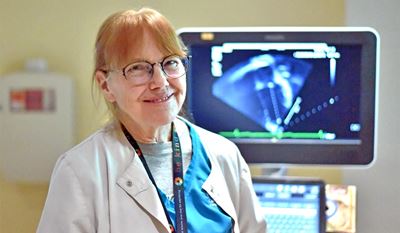
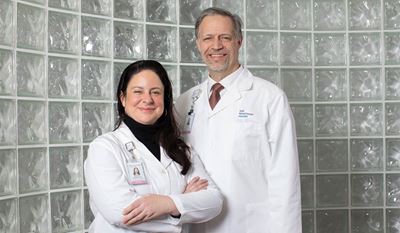
The Cath Lab team at L+M Hospital has worked hard to advance safety protocols that enable elective angioplasty patients to go home the same day of their procedures.
One of the advantages of being part of a health system is being able to adopt protocols that work well elsewhere. With that said, L+M Hospital is now sending most elective angioplasty patients home the same day of their procedures, just like patients at Yale New Haven and Bridgeport hospitals.
L+M has been performing emergency angioplasty for heart attack victims since 2008; soon thereafter it became the first and only Connecticut hospital approved for elective angioplasty procedures without cardiothoracic surgery backup capabilities.
Adding same-day discharges to its elective program is yet another advancement – and a significant patient satisfier, said Christopher Regan, MD, an interventional cardiologist with the Yale New Haven Heart and Vascular Center at L+M and Westerly hospitals and associate professor of Medicine, Yale School of Medicine (YSM).
However, “Our research shows that most complications, if they do occur, typically happen within six hours after a procedure or more than 24 hours after the procedure. It turns out that after six hours – and up to 24 hours – the patient is typically fine,” Dr. Regan said.
As a result, the HVC keeps patients for six hours of observation after their procedure, then discharges them if no complications occur. Staff call patients in the morning to check on the access site and see how they’re feeling.
“What we’ve learned from our colleagues at Yale New Haven and Bridgeport is that this approach is safe, and patients appreciate being able to sleep in their own bed,” Dr. Regan said.
Brian Cambi, MD, medical director of the YNHH Heart and Vascular Center at L+M and Westerly hospitals, praised Dr. Regan and Sarah La Flair, clinical coordinator of the Catheterization Lab, for advancing the elective angioplasty program.
“Because of everyone’s efforts, our patients are going home safely and with far less disruption in their lives,” said Dr. Cambi, who is also associate professor of Medicine, YSM. “This initiative is also reducing costs while opening up inpatient beds for patients who really need them. That makes this an important step forward for our program, for our patients and for our hospital.”