Find a DoctorGet Care Now
Skip to main content
Search icon magnifying glass

Contrast

Contact

Share

Give Now

MyChart

Help

Our policies

The Office of Privacy and Corporate Compliance is committed to providing Yale New Haven Health System, and all of its individual delivery networks, with respect to its vision, mission and values, with clear and ethical compliance direction relating to all federal and state health care program requirements and regulations.

About Us

The YNHHS Compliance Program is designed to prevent and detect violations of applicable law, Code of Conduct and company policies. While it is expected that employees, contractors and agents will comply with applicable laws, Code of Conduct and policies, the System understands that the implementation of the Compliance Program cannot eliminate all risk of improper conduct. In the event that the System becomes aware of possible violations of law or Code of Conduct or policies, the Office of Privacy and Corporate Compliance will investigate the matter and, where appropriate, recommend disciplinary action and implement corrective measures to prevent future violations.

Compliance is not a “policing” action, but a way to ensure everyone is “doing the right thing”. To support this, YNHHS’ Corporate Compliance Department works with departments all across the health system to carry out primary functions such as:

  • Establishing compliance policies and procedures
  • Business structure and responsibility that includes a Compliance Officer and committee
  • Education and training
  • Reporting mechanisms that include effective lines of communication
  • Response/prevention and enforcement through well publicized disciplinary guidelines
  • Monitoring and Auditing
  • Responding to detected offenses and developing corrective actions
  • Comprehensive Fraud and Abuse Plans—procedures to voluntarily self-report potential fraud or misconduct

Once an issue is identified, the Compliance Department works with the applicable departments to investigate and resolve the issue. All issues are recorded and tracked for timely resolution.

Contact Us

We encourage you to call the Office of Corporate Compliance at 203-688-8416 or email us at [email protected] to discuss any potential compliance concerns. In addition, the Compliance Hotline is available to everyone 24 hours a day, seven days a week by calling 888-688-7744 or visiting www.ynhhscomplianceprogramhotline.com.

You can make a report either anonymously or by using you name. All reports received by either the Office of Privacy & Corporate or Hotline are appropriately investigated.


YNHHS Code of Conduct

The YNHHS Code of Conduct is the foundation of our Compliance and Privacy Program. It outlines the duties and responsibilities of the Compliance Program and of those who are associated with and employed by Yale New Haven Health System and its affiliates.

Code of Conduct


Why We Have a Code of Conduct

Our Code of Conduct reflects our collective commitment and responsibility to uphold our organization’s reputation, practice ethical business behavior, meet rigorous professional standards, and comply with the laws, regulations and policies that govern our work.
The Yale New Haven Health System (YNHHS) Code of Conduct applies to every individual affiliated with YNHHS, whether employee, volunteer, member of the medical staff or Auxiliary at YNHHS and its Bridgeport, Greenwich, Lawrence + Memorial, Westerly, Yale New Haven and Northeast Medical Group delivery networks.

The YNHHS Code of Conduct provides:

  • An overview of the commitments that govern our work
  • Tools for reporting concerns or suspected violations without fear
    of retaliation
  • Guidance in making choices that may seem questionable or confusing

We as individuals have a shared commitment to meeting applicable laws and industry standards and applying them to our day-to-day interactions.


Commitment

The YNHHS Code of Conduct articulates our commitment to our values and ethical business behavior while reminding us that our overriding responsibility is
to use sound judgment and personal integrity.

It is the responsibility of each of us to understand and comply with all applicable organization policies and procedures and be able to locate them and review them periodically.


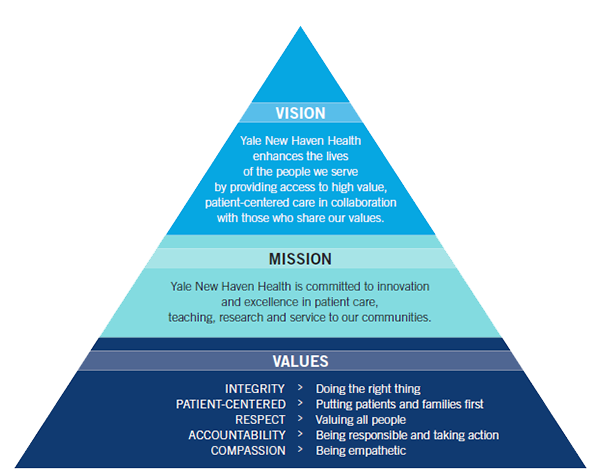
Vision Mission and Values

vision mission values


Corporate Compliance Program

The purpose of the Compliance and Privacy Program is to provide the system with clear ethical and compliance direction. In addition, the Compliance and Privacy Program is designed to prevent and detect violations of applicable law, Code of Conduct, and company policies.

Our Corporate Compliance Program is designed to enhance our understanding of acceptable behavior and appropriate decision-making.

It is everyone’s duty to promptly report any activity that appears to violate the Code of Conduct or any laws, regulations, or organizational policies.

All YNHHS policies (including compliance and privacy) can be found on the YNHHS intranet.


Learn more about compliance

To access the Corporate Compliance Program page on the YNHHS intranet, go to Corp. Compliance/Privacy in the top navigation bar.


How to view compliance and privacy policies

To view specific Corporate Compliance policies, from the corporate compliance intranet page, click "Policies and Procedures" in the upper-left navigation box.


How to Report an Issue

If you wish to obtain guidance on ethics or compliance issues, or if you are unsure about reporting a suspected violation, you may take any of the following actions:

  • Contact your direct supervisor.
  • Contact a higher level of management.
  • Contact Human Resources if the issue involves a human resources concern such as work conditions, discrimination or harassment, theft or abuse of property and personal security.
  • Contact the YNHHS Compliance Office 203-688-8416 or your delivery network Compliance Officer.
  • To make an anonymous report, call the Compliance Hotline at 1-888-688-7744 or visit the Corporate Compliance/Privacy website at https://ynhh.ethicspoint.com/


Calling the Compliance Hotline

If you feel uncomfortable about your activities or those of others around you and are hesitant about making a report in person, call the 24-hour Compliance Hotline at 1-888-688-7744 or make a report on the Corporate Compliance/ Privacy website at: https://ynhh.ethicspoint.com/.

The hotline is outsourced to an independent company that has trained professional personnel available to speak with you. You are not required to identify yourself. The hotline is not set up for caller ID and cannot trace calls.

However, you may decide to identify yourself in order to provide information that may be helpful in an investigation.

Information you provide will remain confidential to the extent possible.

You will be given a case number and a call-back date. You may call back again on or after the call-back date to determine whether action has been taken, but the nature and outcome of an investigation are always confidential.


Non-retaliation for reporting

We will protect any employee who reports a concern in good faith. While you are accountable for your own wrong-doing, anyone who retaliates against you for reporting a concern in good faith will be subject to disciplinary action.

Report any retaliation or harassment immediately to your supervisor, another manager, the Compliance Office or the Compliance Hotline. Please see the YNHHS Non-Retaliation and Non-Retribution for Reporting policy for more information.


Why Call the Compliance Hotline

These are just a few of the concerns that might prompt you to call the hotline:

  • Confidentiality of patient information
  • Improper billing or practices
  • Medical record documentation concerns
  • Conflicts of interest
  • Inappropriate use of YNHHS computers or equipment
  • Workplace safety
  • Theft
  • Any situation which places you, a patient, a co-worker or YNHHS at risk


Key Compliance Topics


Gifts & gratuities

No employee, member of the medical staff, volunteer, or member of the Board of Trustees may solicit or encourage a gift or gratuity from a patient or visitor. When gifts of a personal nature are offered by patients or visitors, they should be discouraged.

The patient or visitor should be politely thanked, but told that employees, medical staff, volunteers and trustees are not permitted to accept gifts or gratuities. YNHHS personnel may never accept cash or cash equivalents, such as gift certificates or gift cards.


Gifts & business courtesies from vendors guidelines

YNHHS personnel may not offer or receive gifts unless such gifts are of a nominal value and are in accordance with these guidelines. Refer to policy on intranet for details.

Under no circumstances may YNHHS personnel offer or receive a gift when the intent is to generate healthcare business. YNHHS personnel must disclose and, as appropriate, seek prior approval from their department manager when receiving or soliciting gifts as YNHHS personnel.


Protection of Patient Health Information (PHI)

Employees and medical staff should request, use or disclose only the minimum amount of information necessary from patients’ records, and only for patient treatment, payment or healthcare operations (TPO). Employees should use caution to never disclose PHI to any non-covered individual through any form of communication – verbal, written, electronic mail, social media, etc.


Social Media

Employees who publish or post content on user-generated media on the internet (including, but not limited to, social media sites, blogs, wikis, chat rooms, message boards, etc.) should exercise good judgment, respect and discretion, and follow YNHHS’ policy on “Social Networking and Online Communications”.
Employees’ right to access Protected Health Information (PHI)

Employees may not use work access privileges to view the records of family members, friends, colleagues or others. Employees are granted access to electronic medical records (EMRs) for treatment, payment, or operations (TPO) purposes only.


Government exclusion from participation

YNHHS does not employ, contract with or otherwise utilize the services of any individual or organization that has been debarred or excluded from, or is otherwise ineligible to participate in, any federal healthcare program.


False claims & payment fraud prevention

All employees, contractors, agents and volunteers of YNHHS must immediately report to the delivery network Compliance & Privacy Officers or Chief Compliance & Privacy Officer any suspicion of fraud, waste or abuse in connection with the business of YNHHS. YNHHS engages in specific compliance efforts to detect and prevent fraud, waste and abuse.


Non-retaliation & non-retribution for reporting

YNHHS prohibits any acts of retribution, discrimination, harassment or retaliation against any employee who, in good faith, provides information or otherwise assists in an investigation or proceeding regarding any conduct which the employee reasonably believes to be in violation.


Compliance Examples


Accessing Family Information

My mother-in-law is in the hospital and I’m a nurse working on another floor. Can I look up her lab results in Epic to see what is wrong and consult with her tonight? No. Family members, friends and co-workers are entitled to the same privacy as any other patient. You must obtain a release of information and request the records through Health Information Management (HIM) or MyChart proxy access.


Social Media

May I post something that includes the YNHHS logo or has patient information on social media? If an employee chooses to be identified as related to the System, its hospitals or other entities, he/she must make it clear to the readers that the views expressed are the employee’s alone and that they do not necessarily reflect the views of the System. Employees must avoid making defamatory statements about the System or its employees, patients, clients, partners, affiliates and others, including competitors. Disclosing any protected or confidential information (e.g., patient/employee/business) on social media or online is prohibited.


Entertainment & Gifts

What if a patient gives me a gift card to my favorite store? This would not be permitted. Thank the patient and direct him or her to your delivery network’s Development/Foundation office to make a charitable contribution.


Patient Privacy

I saw a co-worker photographing a celebrity in the hospital waiting room with his phone. I didn’t take the picture – do I need to report it? This is a breach of patient privacy and you are required to report it.


Patient Billing

I noticed a few instances in which the physician’s office where I work was billing twice for services with a Medicare patient. Should I wait for someone to catch the error later? Billing and coding are high-risk areas and this may be considered a fraudulent claim. It should be reported immediately to your manager and/or the Compliance Department or Hotline.

Policy updated 2/27/2017


Privacy

We are committed to protecting the privacy and confidentiality of your information. For more information about your privacy rights and how we may use and safeguard your personal information, please visit our privacy page. Click here to learn more.


Detecting and Preventing Fraud, Waste, Abuse and Misconduct

Although no precise measure of health care fraud exists, those intent on abusing the system can cost taxpayers billions of dollars while putting beneficiaries' health and welfare at risk. Medicare fraud and abuse increases the strain on the Medicare Trust Fund. The impact of these losses and risks magnify as Medicare continues to serve a growing number of people.   - CMS Medicare Learning Network

It is the policy of the Yale New Haven Health System to provide healthcare services in a manner that complies with all applicable federal and state laws. Such compliance is critical to the Health System's commitment to operating pursuant to the highest business, professional and ethical standards. In compliance with the Federal Deficit Reduction Act of 2005, YNHHS maintains a vigorous Compliance and Privacy Program and has implemented a system-wide policy regarding the detection and prevention of fraud, waste, abuse and misconduct.

Contact Us

We encourage you to call the Office of Corporate Compliance at 203-688-8416 or email us at [email protected] to discuss any potential compliance concerns. In addition, the Compliance Hotline is available to everyone 24 hours a day, seven days a week by calling 888-688-7744 or by visiting www.ynhhscomplianceprogramhotline.com

You can make a report either anonymously or by using your name. All reports received by either the Office of Privacy amp; Corporate Compliance or the Hotline are appropriately investigated.

False Claims and Fraud Protection Policy

PURPOSE

 
The purpose of this policy is to inform employees, contractors, volunteers and agents of Yale New Haven Health System (YNHHS) of the federal False Claims Act (referenced in this policy as "FCA") the Federal Program Fraud Civil Remedies Act, the Connecticut False Claims Act (“CFCA”), and all other state False Claims Acts; to provide general information regarding YNHHS’s efforts to combat fraud, waste, and abuse; and to describe the remedies and fines for violations that can result from certain types of fraudulent activities.

In addition, this policy conforms to the Deficit Reduction Act (DRA) “Employee Education Provision” intended to bolster Medicaid fraud and abuse enforcement with the following:

  1. Establish fraud and abuse policies and an effective and comprehensive education plan; included in annual health stream training “corporate compliance: A Proactive Stance Course”
  2. Provide detailed explanation of administrative remedies pertaining to civil or criminal penalties for false claims.
  3. Provide specific discussion to the rights of employees regarding whistleblower protection under such laws.
  4. Ensure the entity has a non-retaliation policy available to all employees.
     

APPLICABILITY

 
This policy applies to YNHHS, and each of its affiliated entities, its affiliated hospitals (Bridgeport Hospital, Greenwich Hospital, Yale New Haven Hospital, Lawrence + Memorial Hospital, Westerly Hospital, and any other hospital that affiliates with YNHHS), its affiliated providers (including but not limited to Northeast Medical Group and Visiting Nurse Association of Southeastern Connecticut), and each of their subsidiary entities

DEFINITIONS


  1. Abuse- excessive or improper use of a thing, or to use something in a manner contrary to the natural or legal rules for its use. Abuse can occur in financial or non-financial settings.
  2. Fraud- the wrongful or criminal deception intended to result in financial or personal gain. Fraud includes false representation of fact, making false statements, or by act of the hiding of information.
  3. Waste- the thoughtless or careless spending of, mismanagement, or abuse of resources to the harm (or potential harm) of the U.S. government. Waste also includes incurring unnecessary costs resulting from inefficient or ineffective practices, systems, or controls.

POLICY

 
All employees, contractors, agents, and volunteers of YNHHS must not create any false or misleading documents or financial or electronic records for any purpose. No one may instruct you to so.

Reporting Fraud, Waste, or Abuse

All employees, contractors, agents, and volunteers of YNHHS must immediately report any suspicion of fraud, waste, or abuse in connection with the business of YNHHS to the Office of Privacy and Corporate Compliance. YNHHS engages in specific compliance efforts to detect and prevent fraud, waste, and abuse, such as the Corporate Compliance Program. It is the policy of YNHHS that an employee, contractor, or agent of YNHHS who knowingly and intentionally submits a false claim will be reported to the necessary authorities by the Office of Privacy and Corporate Compliance.

The identification of fraud, waste or abuse involving a particular Medicare Advantage organization will be reported to the Medicare Advantage organization to the extent required by law or pursuant to contract. If not provided by the Medicare Advantage organization, the form and manner of such report shall be determined by the Office of Privacy and Corporate Compliance in consultation with the Legal and Risk Services Department.

PROCEDURES

 
If you would like more information on the Corporate Compliance Program and specific compliance policies or on how to report any concerns, please contact the Office of Privacy and Corporate Compliance (203-688-8416). Compliance Policies may also be accessed via the YNHHS Intranet.


Detailed Information of the Federal False Claims Act [31 U.S.C. 3729-3733}

The Federal False Claims Act (FCA) imposes civil penalties on people and companies who knowingly submit a false claim or statement to a federally-funded program or otherwise conspire to defraud the government in order to receive payment. Failure to report and return overpayments from Medicare and Medicaid within certain timeframes might also constitute a violation of the FCA. The FCA also protects people who make efforts to stop the suspected fraud.

The FCA is not confined to healthcare claims, but extends to any payment requested of the federal government or the federal government’s contractor, grantee, or other party, if the payment is to be spent or used on the government’s behalf or to advance a government program or interest and the government provides any portion of the payment or will reimburse the contractor, grantee, or other party. The FCA applies to billing and claims sent from YNHHS to any government payor program, including Medicare and Medicaid.

It is the policy of YNHHS that an employee, contractor, or agent of YNHHS who knowingly and intentionally submits a false claim will be reported to the necessary authorities. Anyone or any company that submits a false claim or statement to the government may be fined under the FCA between $10,957 and $21,916 for each such claim submitted, regardless of the size of the false claim, and the person or company could be required to pay an additional fine of three times the value of any charges. Where a person who violated the FCA reports the violation to the government under certain conditions, the FCA provides that the person shall be liable for not less than double damages.

Part of the FCA's purpose is to create an environment where employees and others feel safe reporting concerns about fraud. Any person, who lawfully attempts to stop any FCA violations or reports information about false claims or suspected false claims that are submitted by others, may not be retaliated against, demoted, suspended, threatened, or harassed for such actions. The FCA also protects individuals who assist in an investigation, provide testimony, or participate in the government's handling of a false claim. Individuals have the right to FCA whistle blower protection from retaliation in any form as to the result of their whistle blowing.

These protections include reinstatement without loss of seniority if fired, recovery of two times lost wages plus interest and recovery of attorney fees and other reasonable costs in connection with pursuing retaliation claim. Confidentiality will be maintained to the extent possible. The FCA’s provisions are generally enforced by the U.S. Department of Justice. The FCA provides that an individual may initiate a formal claim under certain circumstances. If any funds are recovered, a portion of the funds may be paid to the person who initiated the formal claim, at the discretion of a federal court. This amount, if awarded, generally is between 15% and 30% of the total damage amount.

If a person wishes to file a claim regarding fraud or suspected fraud related to a healthcare payment directly with the government, he or she must first present a formal complaint, along with all material evidence relating to the alleged fraud, to the authorities at the U.S. Department of Justice. The authorities have 60 days to investigate, during which time the complaint is kept confidential. Upon completion of the investigation, the government will decide either to pursue the case on its own or decline to proceed with the case. If the federal government declines the case, the individual may still proceed with the case on his or her own, but without the government's assistance, and at his or her own expense.

A private legal action under the FCA must be brought within six years from the date that the false claim was submitted to the government. (A government-initiated claim may be brought up to ten years after the false claim, depending on the circumstances.)

Detailed Information of the Federal Program Fraud Civil Remedies Act

Persons or companies that commit fraud on the federal government, by false claim or statement, can be assessed monetary penalties in addition to the penalties of the False Claims Act because of a law called the Program Fraud Civil Remedies Act (referenced in this policy as "PFCRA"). Specifically, PFCRA penalties of $5,000 per false claim or statement apply if a person or company submits a claim to the federal government that: the person or company knows or has reason to know is false, fictitious, or fraudulent; includes or is supported by written statements containing false, fictitious, or fraudulent information; includes or is supported by written statements that omit a material fact, which causes the statements to be false, fictitious, or fraudulent and the person submitting the statement has a duty to include the omitted fact; or is for payment of property or services that are not provided as claimed.

The $5,000 penalty also applies if a person or company provides written back-up or materials relating to the claim in which the person or company asserts a material fact that is false, fictitious, or fraudulent; or omits a fact that the individual had a duty to include, the omission causes the statement to be false, fictitious, or fraudulent, and the statement contains a certification of accuracy.

State Laws - Connecticut

In 2009, the Connecticut General Assembly enacted the Connecticut False Claims Act (“CFCA”). The CFCA is very similar to the FCA and prohibits any individual or entity from knowingly presenting or causing to be presented a false or fraudulent claim for payment or approval under the medical assistance programs administered by the Connecticut Department of Social Services or knowingly making or causing to be made a false statement in order to get such a claim approved, or knowingly concealing, avoiding, or decreasing any obligation to pay or transmit money or property to the state. Any individual or entity that violates this prohibition can be subjected to civil monetary penalties of $5,000 to $10,000 per violation as well as up to three times the damages sustained by the state as a result of the false claim.

The CFCA provisions are generally enforced by the Connecticut Attorney General. However, like the FCA, under certain circumstances, the CFCA permits private individuals to initiate civil actions and protects these individuals from workplace retaliation. If any funds are recovered, a portion of the funds may be paid to the person who initiated the formal claim, at the discretion of a court. This amount, if awarded, general is between 15% and 30% of the total damage amount. A legal action under the CFCA cannot be initiated more than six years after the date the violation occurs or more than three years after the date when a state official knew or should have reasonably known the violation, but in no event more than ten years after the date that the violation occurs.

In addition, there are also other Connecticut laws that prohibit fraudulent billing. It is a crime in Connecticut to fraudulently bill Medicaid or general assistance programs. All employees, contractors, and agents of YNHHS must immediately report suspicion of any criminal activity, including criminal fraud, to the System Compliance Operations Officer.

Anyone who provides services to a state Medicaid beneficiary and seeks or accepts payment for unnecessary or improper services is subject to possible imprisonment and/or criminal fines under state law. Depending upon the extent of the fraudulent services involved, such offenses carry potentially significant penalties, with a maximum of 20 years in prison and a maximum fine of $15,000.

Anyone who provides services to a recipient of Connecticut's general assistance program and seeks or accepts payment for unnecessary or improper services is also subject to civil and criminal penalties. Depending upon the amount of the fraudulent services involved, such offenses carry a minimum one-year prison sentence and a maximum of 20 years, as well as a maximum fine of $15,000. Any person who defrauds Connecticut's general assistance program is also excluded from participating in the program for a minimum of one year.

Connecticut law protects employees who report suspected violations of state or federal law, including reports of criminal fraud. An employer may not discharge, discipline, or otherwise penalize an employee for reporting a violation of the law, or suspected violation, as long as the employee does not know the information being reported is false.

Other States

Additionally, other state laws inclusive of New York, New Jersey, Massachusetts and Rhode Island will be reviewed as required for compliance purposes.

Non-Retaliation

YNHHS is dedicated to creating an environment where employees and others feel safe reporting concerns about fraud. YNHHS shall not unlawfully retaliate against individuals who: lawfully attempt to stop fraudulent billing practices or violations of the FCA, CFCA, or any other federal or state law or regulation regarding false or fraudulent claims; report information about false claims or suspected false claims that are submitted by YNHHS; or assist in any investigation, provides testimony, or participate in the government’s handling of a false claim investigation.


Approved 4/17/2020

 

Vendor Policy

Yale New Haven Health System Supply Chain Management staff is focused on working with vendors to deliver high-quality supplies, services and equipment, at the lowest total cost.


Financial policies

Billing and Collection

Visit our Resources page for billing information. 

Financial Assistance Program

  • Visit Financial Assistance at Yale New Haven Health for policies, applications and related material.


Language Assistance

Language Assistance Policy

All patients and visitors at Yale New Haven Health and its member organizations have the right to receive information in a language they understand, free of charge. YNHHS complies with the Department of Health and Human Services' Section 1557 rule of the Affordable Care Act — which sets guidelines about language assistance for people with limited English proficiency or those who are deaf or hard-of-hearing — and takes reasonable steps to provide meaningful access to people with limited English proficiency who may require assistance within the health system.

Learn more
(Policy updated 1/1/2020)


Non-discrimination

Non-discrimination Statement

Discrimination is against the law

Yale New Haven Health complies with applicable civil rights laws and does not discriminate against, exclude or treat people differently on the basis of race, color, national origin, age, disability or sex.

Yale New Haven Health:

  • Provides reasonable modifications and free aids and services to people with disabilities to communicate effectively with us, such as:
    • Qualified sign language interpreters
    • Written information in other formats (large print, audio, accessible electronic formats, other formats)
  • Provides free language services to people whose primary language is not English, such as:
    • Qualified interpreters
    • Information written in other languages

If you need reasonable modifications, auxiliary aids and services or language assistance services, contact the Civil Rights/ADA coordinator in Patient Relations at 203-688-3430.

If you believe that Yale New Haven Health has failed to provide these services or discriminated in another way on the basis of race, color, national origin, age, disability or sex, you can file a grievance with: Civil Rights/ADA coordinator, Patient Relations, Yale New Haven Health, 20 York Street, New Haven, CT 06510; 203-688-3430; Fax 203-688-1667; [email protected]. You can file a grievance in person or by mail, fax or email. If you need help filing a grievance, Patient Relations can help you.

You can also file a civil rights complaint with the U.S. Department of Health and Human Services, Office for Civil Rights, electronically through the Office for Civil Rights Complaint Portal, available at ocrportal.hhs.gov/ocr/portal/lobby.jsf or by mail or phone at:

U.S. Department of Health and Human Services
200 Independence Avenue, SW
Room 509F, HHH Building, Washington, D.C. 20201
1-800-368-1019, 1-800-537-7697 (TDD)

Complaint forms are available at
www.hhs.gov/ocr/office/file/index.html

(Policy updated 10/24/2024)