Published January 29, 2026
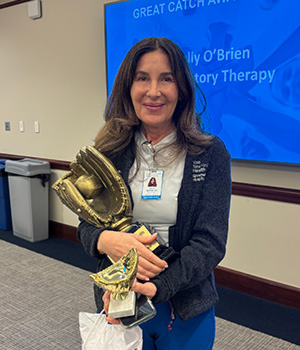
Sally O’Brien, RN, Wound Care, earned the Great Catch Award for demonstrating outstanding attention to detail and commitment to safety before a patient received treatment in the oxygen-rich hyperbaric chamber. After her patient answered all safety questions appropriately, O’Brien began positioning the patient in the chamber. Noticing something under the patient’s gown, O’Brien discovered a medical alert necklace that could have posed a serious hazard in the chamber. By removing the device and reminding the patient about the safety risk, O’Brien prevented a serious event.
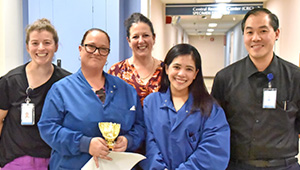
Mariann Dinelle, RN, clinical coordinator at Smilow Cancer Hospital at Westerly, received a Great Catch Award for her outstanding attention to detail and commitment to patient safety. Dinelle’s patient was receiving Vancomycin, a potent antibiotic that requires careful monitoring because low levels can render it ineffective, while high levels can damage the kidneys. During routine morning labs, the patient's Vancomycin level came back significantly lower than the previous day’s result. Recognizing this discrepancy as unusual, Dinelle called the Lab, which re-ran the test. The level came back within a safe range. This correction was important because the incorrect low number could have led to an unnecessary dose increase.

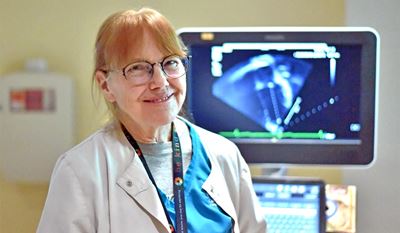
When Medical Lab Scientist Jennifer Beaulieu received a blood type order for a patient, the test came back as “A positive.” However, when Beaulieu checked the patient’s history, the blood type was listed as “O positive.” Beaulieu practiced a questioning attitude and called the Emergency Department to communicate the discrepancy and request a redraw. By stopping the line, she not only prevented a mistake during the type and screen process, she prevented other potential mistakes.
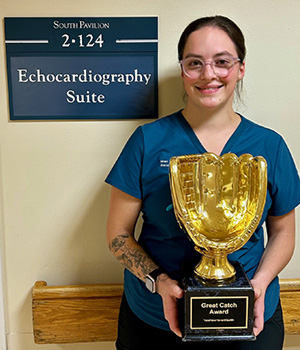
Kaitlyn Dipisa, sonographer, Heart and Vascular Center, was recognized for practicing a questioning attitude and 200% accountability. During a procedure, she noticed a patient was having difficulty completing sentences. She confirmed with the patient’s daughter that the problem had started several days before the visit. Dipisa escalated her concerns to a physician, who agreed the patient should be evaluated in the Emergency Department. The patient was found to have experienced a stroke, which may have resulted in severe complications if she had not received timely treatment.