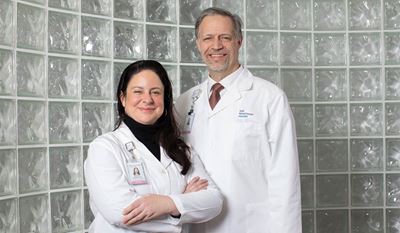
Diane Hitchcock in an Ultrasound suite at L+M Hospital.
Diane Hitchcock was a 23-year-old Connecticut College graduate with a degree in biology when a doctor she knew at L+M Hospital offered her a job; it was 1976.
“He said, ‘Hey, we’re doing this new thing. I’m getting this new machine that uses sound waves to see inside the body,’” Hitchcock recalled. “Come on in, we’ll try it.”
So began Hitchcock’s 50-year ultrasound career. Today she works per-diem as a technologist in the Yale New Haven Health Pediatric Echocardiography Clinic, serving patients at the clinic’s L+M and Old Saybrook locations.
The doctor, John Sutphen, MD, saw in Hitchcock a smart, enthusiastic woman he believed could help him build an ultrasound program from nothing.
Dr. Sutphen had the ear of then hospital president John Mirabito, a proponent of innovative care. Dr. Sutphen, who had been fascinated by sonar while serving in the Navy, convinced Mirabito to let him try ultrasound. The Auxiliary of L+M helped purchase that first sonography device and a new era in diagnostic care began in New London.
“The big hospitals, including Yale New Haven, had ultrasound, but I believe we may have been the only other hospital in the state to have it at that time,” Hitchcock recalled.
What they had, however, only vaguely resembles the high-quality ultrasound care that is standard today across Yale New Haven Health.
“Back then, everything we did was by the seat of our pants,” Hitchcock said with a laugh. “There were two professional groups back then – the Yale Medical Ultrasound group and the Connecticut Society of Echocardiography. We would all meet about once a month and bring printouts of images. We’d say to each other, ‘Has anyone ever seen anything that looks like this?’”
Today’s technological advances have only enhanced Hitchcock’s mission to deliver the highest-quality images. She, too, marvels at the two-, three- and even four-dimensional images of unborn babies, some of whom are yawning or even smiling.
“Back then you didn’t actually see the beating heart,” Hitchcock said. “There were no real-time ultrasounds. But we could see if the bladder was full and then know if the kidneys were functioning.”
Today’s high-resolution ultrasounds of pregnant mothers are fun for families, “but they are also diagnostically valuable,” Hitchcock said. “They truly help diagnose what’s going on inside patients’ bodies.”
Working in the Pediatric Echocardiography Clinic, Hitchcock’s longevity adds poignancy to her role. “It’s hard to sum up a career,” she said, smiling, “but I plan to keep doing it. I enjoy coming to work. And I really like the patients. I see patients I knew when they were kids, and now they’re coming in with kids of their own; I feel like they’re my grandchildren.”