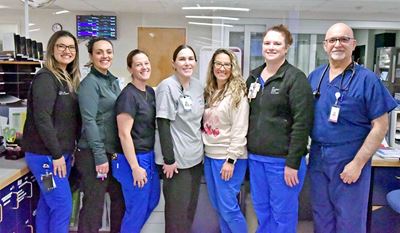
L+M has launched a Trauma Survivors Network (TSN) program to provide patients with additional resources and support. From left are: Jessica Mancarella, RN, Trauma Program manager; Kate Lennard, RN, trauma performance improvement coordinator, L+M; Norman LaFleur, TSN peer volunteer; and Stephanie Joyce, MD, medical director of Trauma at L+M and assistant professor of Surgery at Yale School of Medicine.
Every year, nearly 1,000 patients are treated at Lawrence + Memorial Hospital after experiencing a traumatic injury that may permanently affect their lives. Many wonder what their future will hold. A program that has been in operation at Yale New Haven Hospital and expanded to L+M can answer these questions and help provide a path to a new normal.
Trauma is the number one cause of death for people ages 1 to 46. In the United States, more than 150,000 deaths and more than 3 million non-fatal traumatic injuries occur annually. Trauma is defined as a bodily wound or shock produced by sudden physical injury. Causes may include violence or accidents such as vehicle crashes, severe falls, gun or knife wounds, blunt force, or other incidents, according to Stephanie Joyce, MD, medical director of Trauma, L+M Hospital, and assistant professor of Surgery, Yale School of Medicine.
L+M is pursuing Level III Trauma Center verification and designation, with an initial visit by the American College of Surgeons expected this November.
“Hospitalization following a traumatic injury can be filled with uncertainty, pain, anxiety and frustration. These injuries can alter life in an instant, and recovery can be long and challenging,” said Jessica Mancarella, RN, Trauma Program manager. “Our goal is to provide resources for patients and families as they work to rebuild their lives.”
The Trauma Survivors Network (TSN), a program of the American Trauma Society, is a national network that connects survivors and their families with others who have sustained similar injuries. The network offers resources such as a patient/family handbook, peer support groups, multiple online programs, and a Peer Visitation Program that connects trauma patients with volunteer trauma survivors. YNHH became a TSN-affiliated facility in 2019.
L+M joined the TSN to deliver additional psychological support and improve patient outcomes that are not solely related to trauma-related injury, Dr. Joyce said.
L+M’s Peer Visitation Program currently has two volunteers with plans to recruit more.
“Since they have lived through the trauma recovery experience themselves, including the rescue scene, hospitalization, rehabilitation and return home, TSN peer visitors relate to new trauma patients’ concerns on a deeply personal level,” Mancarella said.
L+M TSN peer volunteer Norman LaFleur of East Lyme understands the importance of talking to survivors after a trauma event. In 1993, he lost his left leg after a sudden life-threatening case of heparin-induced thrombocytopenia.
While recovering in a North Carolina hospital, LaFleur received a visit from a local doctor. “He said my surgeon had asked him to talk with me. Then he pulled up his pant leg and showed me his prosthesis,” LaFleur said.
The doctor told LaFleur he would still be able to do things he used to do – like drive his manual car and work. “I needed to hear that. I needed to know that I could get back on my feet and provide for my family,” LaFleur said. “He gave me hope.”
Now as an L+M peer visitor, LaFleur brings hope to others in similar situations. “I share my story. I talk to new amputees about what will be possible in six months, a year, and for the long term. It takes away the unknown. Seeing me helps them visualize what their life can potentially be like,” he said.
To request a referral to the TSN, email [email protected]. For more information, contact Mancarella, 860-271-4812, or Kate Lennard, RN, Trauma Performance Improvement coordinator, 959-201-5269.