Neurosciences Center will expand access to life-saving care
Published September 18, 2025
On the YNHH Neuroscience ICU, critical care neurologist Jennifer Kim, MD, PhD, assistant professor of Neurology, Yale School of Medicine (right), reviewed data on the neuromonitoring system with Lauren Nelson, MD, clinical fellow (left), and Dana Murphy, PA, Neurology. The Adams Neurosciences Center will also feature advanced neuromonitoring technology.
There’s no such thing as a “typical” neurocritical care patient.
People requiring this high level of specialized care may have suffered severe stroke, ruptured brain aneurysms, uncontrolled seizures or cardiac arrest. Others may have traumatic injuries, severe infections, complex tumors of the brain and/or spinal cord or other life-threatening diagnoses.
“Many patients in the hospital require neurocritical care input,” said Emily Gilmore, MD, director, Neuroscience Intensive Care Unit, Yale New Haven Hospital; and clinical chief of Neurocritical Care and Emergency Neurology and professor of Neurology and Neurosurgery, Yale School of Medicine. “We work on care teams that closely collaborate with other neurology and neurosurgery specialists and medical and surgical specialists from a variety of fields.”
Dr. Gilmore is a neurology-trained neurointensivist, specializing in the care of critically ill neurological or neurosurgical patients. The diversity of patients she and her colleagues treat is reflected in the real estate they cover. In addition to the 19-bed Neuroscience Intensive Care Unit (Neuro ICU) on the York Street Campus, neurointensivists work with patients in the Emergency Department, Epilepsy Unit, Smilow Cancer Hospital, Medical and Surgical Intensive Care Units, Heart and Vascular Center and other areas.
That won’t change when the Adams Neurosciences Center opens at the Saint Raphael Campus in 2027, but the number of beds for neurocritical care patients will nearly quadruple. The York Street Campus Neuro ICU will remain open, and the Neurosciences Center will have a 28-bed Neuro ICU.
“With a larger footprint across two campuses and a new Intermediate Care Unit, we will be able to provide cutting-edge care to patients from across the state and region throughout their acute-care continuum,” Dr. Gilmore said.
The Center will also have a 28-bed Neuro Intermediate Care Unit providing a stepped-down level of care. Currently YNHH has just three neuro stepdown beds, with patients being cared for in other units.
“Instead of getting bottlenecked in the ICU, patients ready for stepdown care will have a seamless transition,” Dr. Gilmore said.
The Neurosciences Center will also expand and enhance existing capabilities in the diagnosis, monitoring and rehabilitation of neurocritical care patients. These capabilities include invasive and noninvasive neuromonitoring techniques to measure brain physiology, including fluid pressure, blood flow and electrical activity in the brain and nervous system, along with intraprocedural neuromonitoring that provides real-time data during interventions. In addition, patients will be offered unique opportunities to participate in multicenter clinical trials as well as homegrown research protocols not offered elsewhere in the region.
“We’ll be able to provide the most advanced, patient-focused care in the state,” Dr. Gilmore said. “This allows us to really tailor our treatment approaches to each patient and provide personalized care.”
Despite the fact that they’ll still see patients throughout the hospital, neurointensivists will be closer to their neurology and neurosurgery colleagues, along with nurses, pharmacists, therapists and other healthcare professionals with neurosciences expertise.
“The Neurosciences Center is being designed to make it even easier for the entire clinical team to collaborate throughout each patient’s continuum of care, starting with the prehospital setting, during hospitalization and through early recovery,” Dr. Gilmore said.
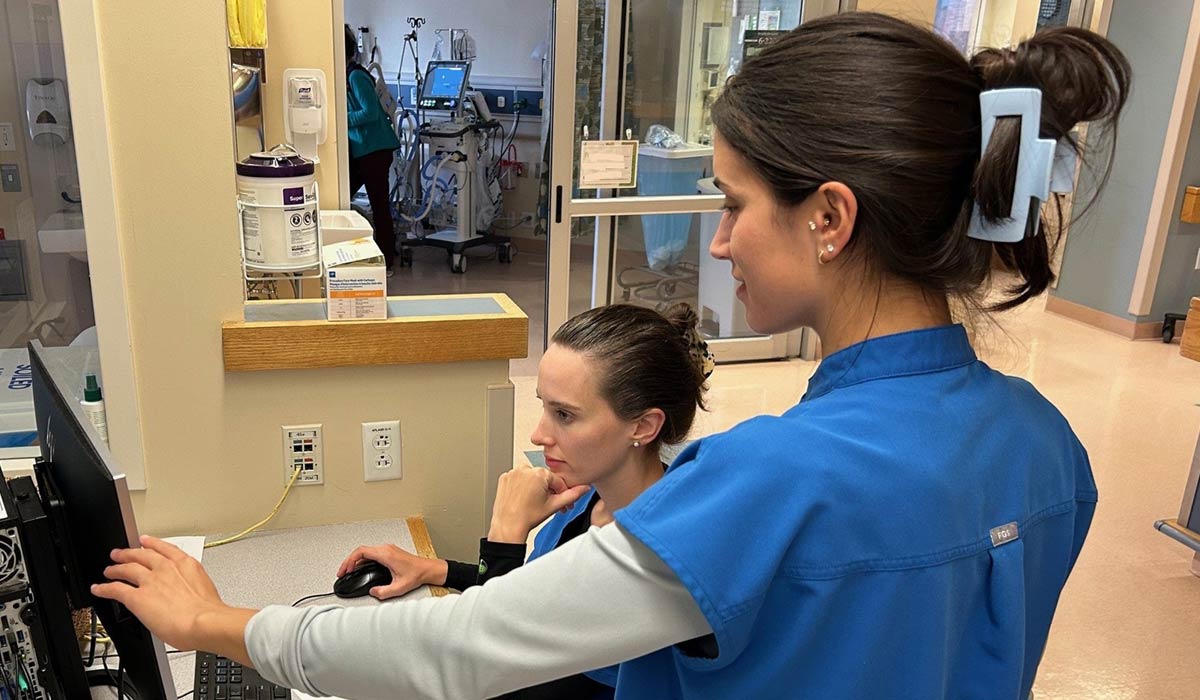
Neuro ICU nurses Kayla Billington, RN (seated), and Veronica Vodola, RN, checked a patient’s status at the York Street Campus Neuro ICU. In addition to physician specialists, nurses, pharmacists, therapists and other healthcare professionals with neurosciences expertise care for patients on the unit.
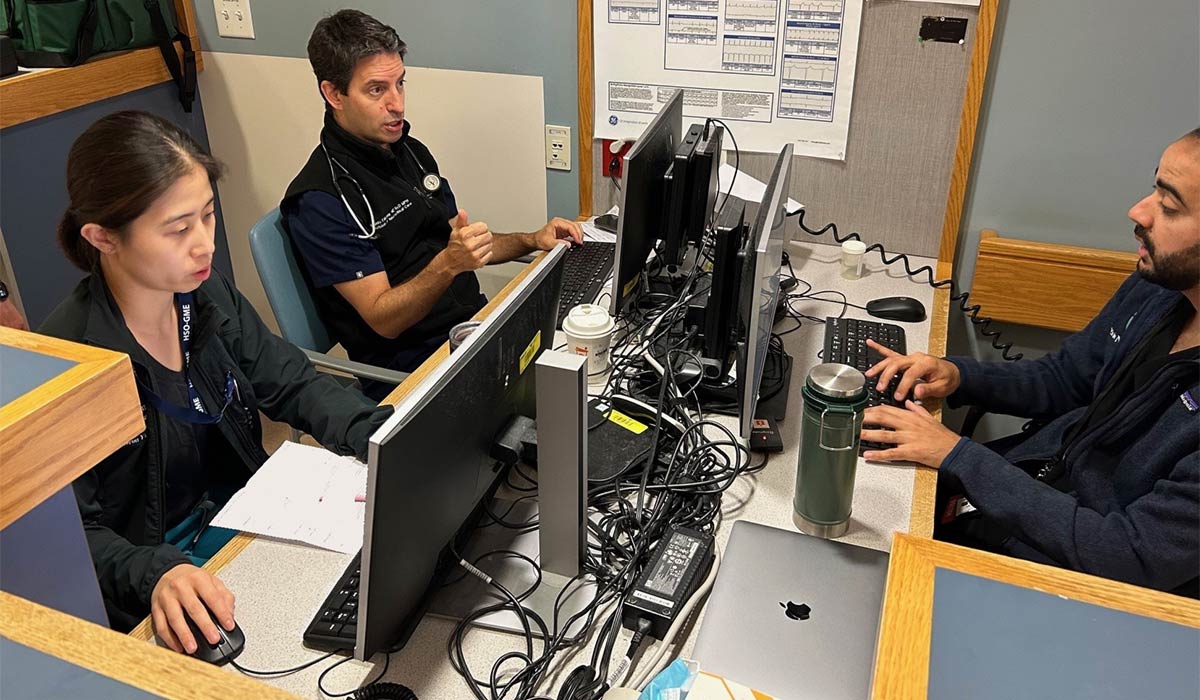
Guido Falcone, MD, ScD (center), academic chief, Neurocritical Care, and associate professor of Neurology, Yale School of Medicine, led rounds recently on the Neuro ICU at YNHH’s York Street Campus. This 19-bed unit will continue to operate after a 28-bed Neuro ICU opens at the Adams Neurosciences Center.