Published February 17, 2026

After easily conceiving their first child, Michael and Connie Bakutes were puzzled when they began trying for a second child and nothing happened.
After roughly nine months, they decided to talk to a doctor.
“Connie went to get checked out first, to see if there were any issues, but nothing came back on her side,” Michael said. “So that’s when I went for some tests.”
Michael’s test results surprised them both. “I found out I didn't have any sperm,” Michael said. “We didn’t know how to take that, because we had just conceived our daughter about a year and a half ago.”
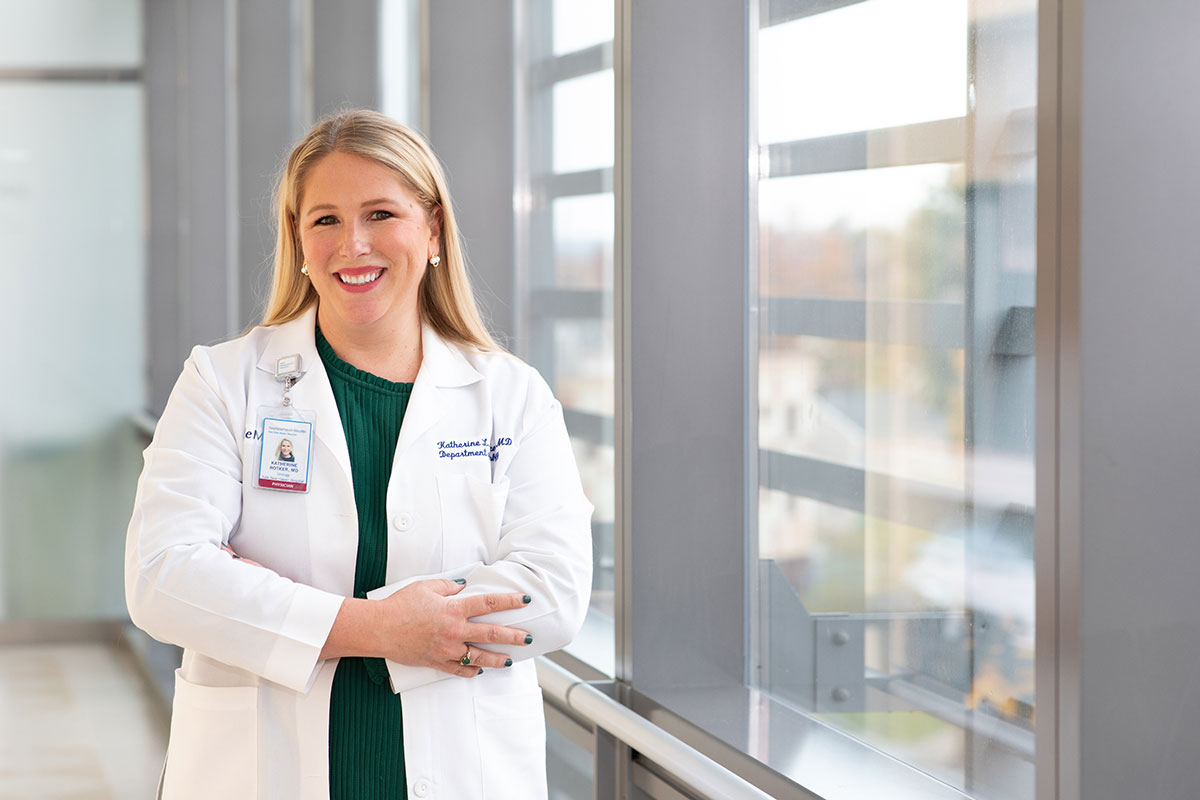
Michael was referred to Katherine Rotker, MD, a urologist with L+M Hospital, Yale New Haven Health, and an associate professor of Urology with Yale Medicine. Dr. Rotker specializes in male infertility and reproductive health.
“Mike had what we call secondary infertility, which is not rare,” Dr. Rotker said. “This is when a man has been able to conceive a first child, but have difficulty expanding the family. In many cases with infertility, people assume it must be a female issue, but, about 50 percent of the time, there’s a male factor contributing."
In fact, when no sperm are seen in the semen, "the causes tend to fall into two big categories,” Dr. Rotker explained. “One is a blockage issue with the tubes that carry the sperm. The other is a production issue, when a man is not making the sperm.”
In Michael’s case, it was clear he had been making sperm when the couple conceived their first child, so Dr. Rotker began a more thorough investigation.
“We found that Michael had something called a varicocele,” Dr. Rotker said. “It’s one of the more common findings we see in men with infertility. Varicoceles are dilations of veins that carry blood from the testicles to the heart. They’re very common, and one in five men have varicoceles. They’re not dangerous and they don’t cause cancer, but, sometimes, they can impact sperm production.”
Dr. Rotker was able to fix the varicocele through a same-day surgical procedure. Knowing the family’s desire for a second child, she also performed a testicular sperm extraction/biopsy at the time of a varicocele repair. Dr. Rotker extracted the sperm at that time of the operation to ensure that the couple would have a chance to conceive another baby, just in case sperm production didn’t fully return after the removal of the varicocele. This sperm was frozen to be later used for invitro fertilization, or IVF.

With the help of the Yale Fertility Clinic in Orange, Michael and Connie were able to conceive a second child through IVF, a process by which the female’s egg is fertilized by the male’s sperm in a laboratory setting; the fertilized egg is then transferred to the female uterus for pregnancy.
“We were thrilled to be able to help Mike and Connie expand their family,” said Hugh Taylor, MD, chair of Obstetrics, Gynecology and Reproductive Sciences for Yale New Haven Health, chief of Ob/Gyn for Yale New Haven Hospital.
Dr. Taylor noted that the Yale Fertility Center can help couples of all kinds with a variety of reproductive issues. “The clinic provides comprehensive care by a team that specializes in more than general infertility,” he explained. “We have individual experts in male fertility, endometrioses, fibroids, polycystic ovary syndrome, miscarriage and more. Whatever the etiology is of a couples’ fertility, we have a specialist to treat it.”
Since success rates vary widely, there was no guarantee for Michael and Connie. “We both held our breath,” Connie recalled. “However, within a few months, were able to conceive baby Jack. After a lot of heartache, stress and sadness, came joy.”
The couple’s first child, Sienna, finally had a younger brother. Baby Jack was born healthy at Yale New Haven Hospital.
“Dr. Rotker was great throughout the entire process,” Michael said. “We’d been waiting for about a year and a half, but to finally have our family together, it was everything we had hoped for. Our kids are at the age now where they’re playing together, so it’s really wonderful.”
Michael said he and Connie were willing to share their story because they thought it might help other couples having difficulty getting pregnant. “Don’t lose hope, and don’t be afraid to get checked out if there’s any issue,” he said. “For guys, it’s nothing to be ashamed of, and the sooner you get in, the faster you can get things moving along.”
Dr. Rotker said helping families conceive is among the highlights of her profession. “It’s one of the best parts of working with male infertility,” she said. “There are so many wonderful stories about couples being able to expand their families, and it’s such a beautiful miracle when it happens. Being able to assist, even in a small way, is such a gratifying part of the job.”