Published March 05, 2026

When 44-year-old Thema Graves woke up one night this January, she immediately knew something was wrong.
“The left side of my body was not functioning. It was numb, and so my partner took me to the emergency room,” she said.
Graves had experienced a stroke and spent the next few days receiving care at Yale New Haven Hospital. She was then transferred to Yale New Haven Hospital’s Rehabilitation and Wellness Center at Bridgeport Hospital Milford Campus for two weeks.
For stroke survivors, rehabilitation is often an important, yet physically and mentally challenging part of their journey. Graves had physical and occupational therapy every day, along with speech therapy three times a week.
“It was rigorous, but it also helped me to see improvements faster than I thought I would see them,” Graves said. “It was also fascinating for my family, who was able to witness the changes that were happening.”
“No two stroke patients are exactly alike. Even if they have a stroke in similar parts of the brain, it really depends on a lot of factors on how they'll present,” said Amy Mooney, MPT, supervisor at the YNHH Rehabilitation & Wellness Center. “Some patients deal with more fatigue than others after the stroke. Many people after a stroke do have impairments in their cognition, so they could have problems even recognizing their deficits from the stroke. They may have trouble with communication, and those can complicate a recovery.”
Mooney explains that therapy can help the brain recover and gives patients the ability to regain function they may have lost. Data shows that in the long-term, patients have better outcomes if they participate in rehabilitation.
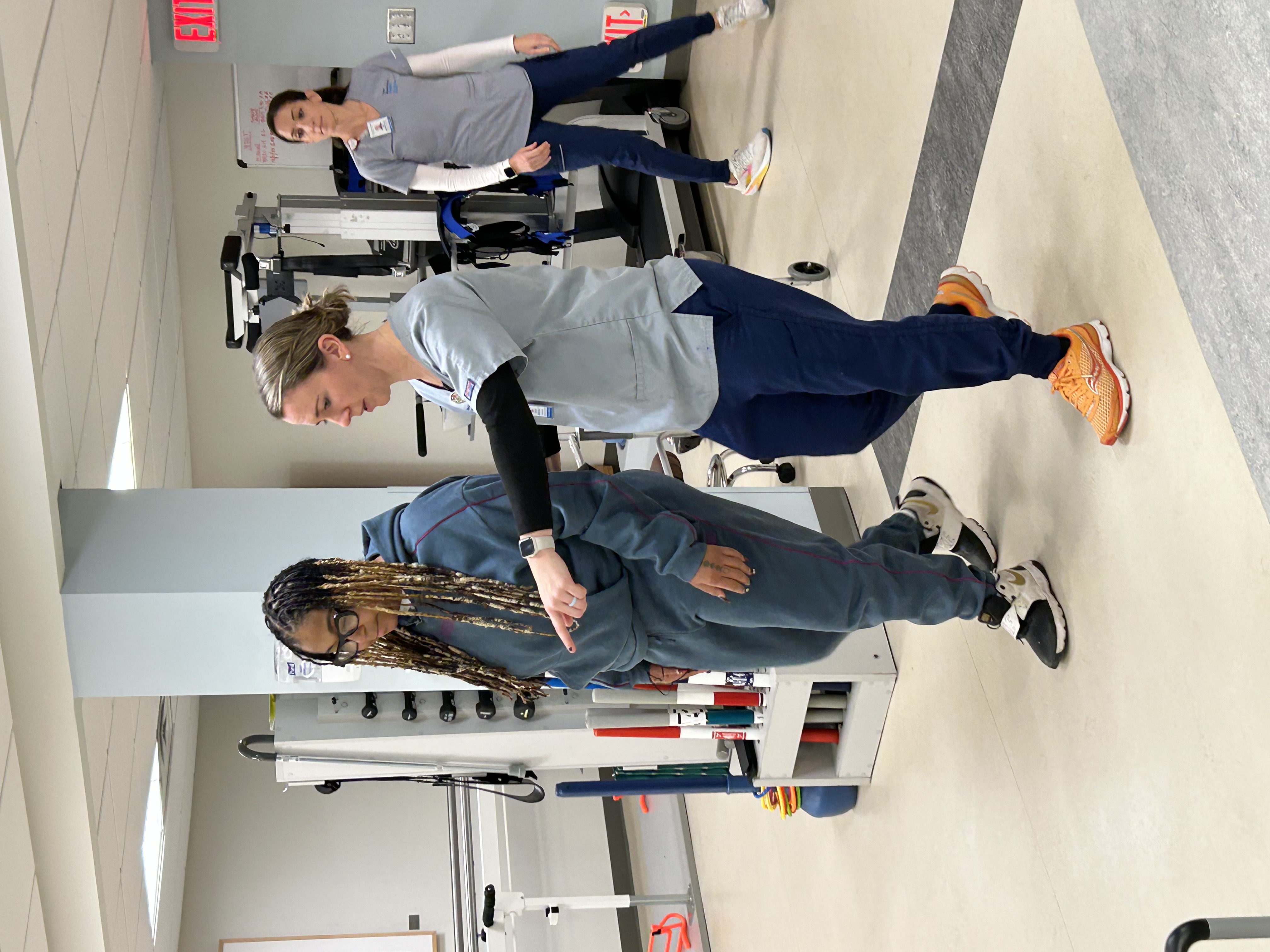
At the YNHH Rehabilitation & Wellness Center, all patients receive a personalized care plan designed to address their needs. For Graves, that meant working with physical therapist Eric Caracuzzi, DPT, on strengthening her left leg and mobility. She worked with Karen Russo, OT, on improving function for daily activities such as getting herself dressed and brushing her teeth, as well as improving fine motor skills. Camille Kefor, SLP, helped with speech as Graves had some weakness in the muscles of her face and also worked on high level cognitive tasks required of her occupation.
The center also cares for post-trauma patients, post-op patients, those who experienced a brain or spinal cord injury, as well as those with other neurologic conditions such as Parkinson’s, ALS or MS.
"What distinguishes our unit is our commitment to delivering patient-centered, individualized care grounded in the Joint Commission’s gold standards for post-stroke rehabilitation. We offer specialized services with dedicated one-on-one attention from physicians and clinicians, including one-on-one therapy, complemented by highly personalized, expert nursing care to support each patient’s recovery journey,” said Necolle Morgado-Vega, DO, medical director of the YNHH Rehabilitation & Wellness Center and associate professor of Orthopaedics and Rehabilitation at Yale School of Medicine.
After her discharge, Graves continued to participate in rehabilitation at home. While she has made big strides, some daily tasks remain a challenge, such as walking up flights of stairs. However, her rehabilitation stay has helped to inspire her healing journey.
“When you enter a rehab facility, the energy of the team is very important. The Milford rehab had a positive environment and I’m grateful for that,” she said. “The energy of the people around you, they’re very kind and were always hyping me up and making me feel like I was doing well. And it made me want to push myself to do better.”
Learn more about services offered at the Yale New Haven Hospital’s Rehabilitation and Wellness Center at Bridgeport Hospital Milford Campus.