A New Treatment for BPH: A Patient’s Journey to Relief With Aquablation
By William Hanrahan
Published January 13, 2026
Steve Gatcomb at his home in Gales Ferry not long after his Aquablation procedure.
Steve Gatcomb of Gales Ferry said his difficulty urinating began when he was about 62. No big deal, initially, but it grew worse, slowly, over the years; eventually his world began to shrink.
Dinner out with his wife became an anxiety ridden ordeal. Road trip adventures became things of the past. As the condition continued to worsen, repeated trips to the bathroom led to pain, frustration and worry.
“I was having major issues,” Gatcomb said. “You have to go really bad but you can’t go. You keep going back to the bathroom because the pressure is always there.”
Eventually, the problem got so bad that Gatcomb, now 69, had to visit the Emergency Department at L+M Hospital. The first time, doctors gave Gatcomb a medication that helped relax his muscles so that he could empty his bladder, and he went home with a prescription. After a second emergency visit, Gatcomb received a referral to see Timothy Tran, MD.
Dr. Tran is a urologist with L+M and Yale New Haven Health. He’s also an associate professor of Urology at Yale School of Medicine. During their initial consultation, Dr. Tran listened carefully to Gatcomb’s story. Just recently, Dr. Tran had started performing a new procedure at L+M called “Aquablation.” When he had all the details, he told Gatcomb that he was an ideal candidate for the procedure.
What is Aquablation?
Dr. Tran explained that Aquablation is a minimally invasive, robotic-assisted surgical procedure using a high-velocity, heat-free waterjet to remove excess prostate tissue. The procedure has the ability to provide long-lasting relief for men with Gatcomb’s condition, known as benign prostatic hyperplasia (BPH).
BPH is a very common non-cancerous enlargement of the prostate gland; the gland’s enlarged size squeezes the urethra, disrupting the ability to urinate.
“With Aquablation, we use the precision of robotics while harnessing the heat-free power of water,” Dr. Tran said. “Aquablation’s high-pressure saline removes excess prostate tissue which relieves the pressure the prostate has placed on the urethra and the bladder. The procedure combines real-time visualization using a cystoscope – a thin camera – and ultrasound imaging to give us a complete, multi-dimensional view of the prostate.”
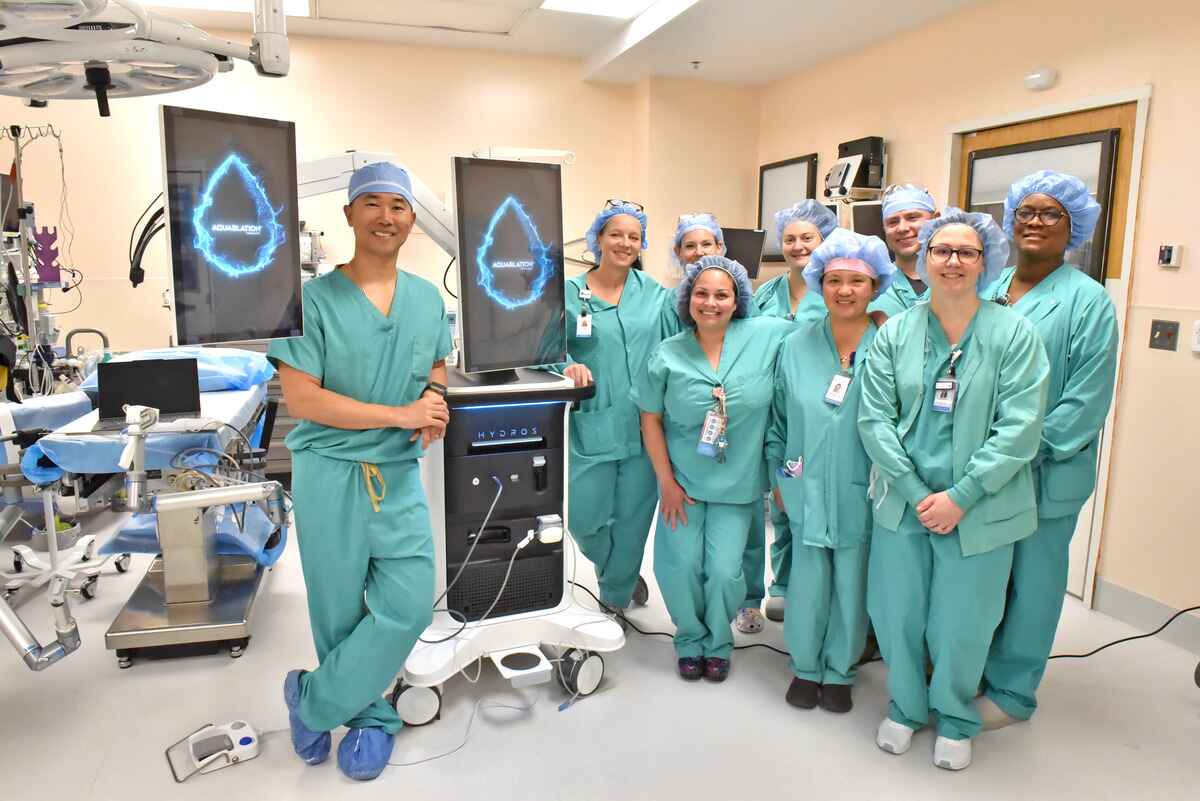
Dr. Timothy Tran, left, in the Operating Room at L+M; the OR staff is also trained to assist in the Aquablation procedure to help men with benign prostatic hyperplasia (BPH).Gatcomb was ready. “Dr. Tran told me it was a great alternative for people with my condition, and we scheduled it,” he said. “I was suffering so much that I was actually excited to have surgery.”
The treatment is performed in the hospital under anesthesia. A one-night stay is typical to monitor for any complications, and Gatcomb went home the next day. Yes, he had to come back a couple of days later for follow-up care, but even that minor inconvenience was of little concern compared to getting his health and freedom restored.
“I can do things again!” he said. “The first time I went to the bathroom after this was over, I was like, ‘Are you kidding me!’ I thought I was 12 years old again. I couldn’t be happier with the result. The anxiety I had, it’s all gone now.”
Steve Gatcomb has advice for other men suffering from urinary issues such as BPH: “You don’t have to be nervous about it. The doctor and the staff, they understand where you’re at.”On a follow-up visit with Dr. Tran, Gatcomb was so pleased that he agreed to tell his story publicly, and for a reason. “A lot of guys, they don’t want to deal with issues like this, and that’s what I’d really like to get out there more than anything,” Gatcomb said. “Hey guys, we know you’re very nervous about this, but you don’t have to be nervous about it, because the doctor and the staff, they understand where you’re at.
“The team in that L+M Urology office, they are wonderful,” Gatcomb continued. “The nurses, they understand your level of vulnerability, and they make you feel comfortable even with an uncomfortable procedure. They are so compassionate and empathetic. They treated me like an intelligent human being, understanding where I was emotionally. That was so impressive. And Dr. Tran – he’s great. He’s good to talk to. He understands.”
There are other benefits to Aquablation as well, Dr. Tran said. “Men have a lower risk of sexual side effects, a faster recovery, and better durability compared to traditional surgical approaches,” he said.
Approximately half of men have some degree of BPH by age 60, and the prevalence increases significantly with age, reaching 80 percent in men over 70. It is estimated that BPH affects more than 42 million men in the US and over 660 million men worldwide.
Yale New Haven Health’s free monthly email newsletter features the latest content from our consumer wellness blog News & Knowledge. Articles cover topics including trending health issues, prevention and treatments featuring experts you can trust.