Published October 22, 2026

A recent demonstration day showcased the advanced equipment and innovative therapies that will support patient rehabilitation and recovery at the Adams Neurosciences Center (ANC).
“Cutting-edge technology and innovative rehabilitation programs can make a profound difference in a patient’s recovery journey,” said Morgan Hills, executive director, Rehabilitation Services, YNHHS. “By combining evidence-based treatment with innovative tools, we can help individuals recovering from stroke and other neurological conditions, movement disorders, and speech and swallowing challenges achieve better outcomes and reach their fullest potential.”
Demonstration day guests experienced a therapy system that incorporates virtual reality, mixed reality and functional reality environments. The system immerses patients in real-world scenarios while guiding exercises designed to improve coordination, spatial awareness, attention and reaction time.
Robert Fogerty, MD, senior medical director, Clinical Leadership, YNHH, and associate clinical professor of General Internal Medicine at Yale School of Medicine, was struck by the system’s realism.
“When the grocery cart moved, I could feel my body moving right along with it,” he said. “The immersive experience is an exciting tool that our patients will find incredibly helpful in their healthcare journey.”
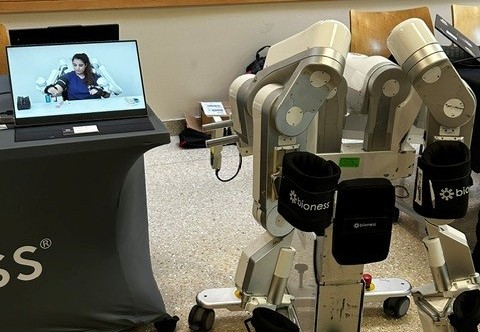
Additional rehabilitation technologies on display included a bilateral upper-extremity exoskeleton that’s strapped to patients’ arms. It mirrors natural human movement and enables high-intensity functional therapy.
A three-dimensional body-weight support system partially supports a patient’s weight while allowing unrestricted movement in any direction. It can be used in a simulated workspace to put patients through activities of daily living. With a focus on fall prevention, the system safely allows patients to train at higher intensities.
YNHHS is the first health system in the region to offer the bilateral upper extremity exoskeleton device and the 3D body-weight support system.
Advanced technologies that support speech-language pathology will also play an important role in patient recovery. Specialized systems for treating swallowing disorders and speech dysfunction provide immediate visual feedback and track progress over time, helping clinicians tailor and adjust treatment plans.
A speech-generating device that can be controlled through eye-gaze technology is one example of the assistive technology that will help patients with communication challenges related to conditions such as cerebral palsy, ALS, Rett syndrome and spinal cord injury.
“Losing the ability to communicate can be profoundly isolating,” said Ruchi Rana, speech language pathologist, Rehabilitation Services, YNHH. “Giving patients the ability to access speech and express their thoughts, needs and wishes is incredibly important.”
Hills emphasized that rehabilitation extends far beyond physical recovery.
“Recovery is about more than regaining physical abilities,” he said. “It's about restoring a person’s ability to communicate, connect and participate fully in daily life.”