The first two patients to have robotic donor nephrectomies at Yale New Haven Hospital (YNHH) this past May each willingly made the decision to donate one of their kidneys to help save their husbands from life-threatening kidney disease.
Both Susan Devine, 65, of New Fairfield and Deepa Babu, 50, of Farmington – the first and second patients, respectively, to have the operation – made their choice out of selfless love. They each proved to be matches, they overcame their natural anxieties, and they eagerly awaited their surgeries.
The only thing that gave both women pause, however, was when they were asked if they would agree to have the procedure performed robotically.
“I was a little nervous because I knew robotic donor nephrectomies were something new,” Babu said. “But I spoke to my surgeon, Dr. Kim, and she was so kind to answer all my questions and explain everything in detail. Her kindness, professionalism, expertise and compassion gave me confidence. I did my own research, too. I learned that the recovery was easier with robotics, and it’s more
precise than traditional laparoscopic surgery. And there’s less chance of error. I even said to my husband, ‘They’re offering robotic surgery as an option, should I take it?’ And he was like, ‘Go for it!’”
Devine offered a similar perspective. “I was nervous about the robotics part because I’d never heard about it before,” she said. “But my hesitation was pretty short lived because Dr. Kim explained everything. She’s a super hero. She exudes confidence. You just realize you’re in good hands with her. She’s young, she’s dynamic, she’s confident; you can just see it.”
The benefits of robotic donor nephrectomy
Both women were referring to Michelle Kim, MD, MS, a transplant surgeon at YNHH and an assistant professor with the Division of Organ Transplantation & Immunology, Yale School of Medicine. Working with the support of the YNHH Transplantation Center team, Dr. Kim was the surgeon at the controls of a da Vinci 5 Robotic Surgical System for each woman’s successful operation, and she suggested the robotic option for good reason.
Stationed near the patient in the operating room, Dr. Kim directly controlled every movement of the robot’s arms via a console. At the console, Dr. Kim uses her hands, fingers and wrists to manipulate the robotic arms as they precisely mimic her movements. But since the robotic arms are much smaller than human hands, Dr. Kim can cut, grasp and suture a patient through extremely small incisions. Robotic arms also eliminate any natural hand tremors a human might have, making every procedure more precise and steadier – and therefore safer.
Dr. Kim explained that the adoption of robotic techniques for nephrectomy at YNHH is part of the hospital’s continual commitment to improving safety and recovery for living kidney donors. “Living donation is a profound act of generosity,” she said. “Robotic surgery allows us to minimize surgical trauma while maintaining exceptional precision, helping improve the overall experience for donors.”
Is robotic donor nephrectomy better than traditional laparoscopic nephrectomy?
Dr. Kim noted that, while robotic surgery delivers similar clinical outcomes compared to traditional laparoscopic methods, 3D visualization and a greater range of motion for the instruments allows surgeons to better navigate complex anatomy, which can be especially valuable in technically challenging cases. The technology may also expand eligibility for living donation by enabling procedures in patients with prior abdominal surgeries or more complex anatomical considerations.
Each operation typically includes about four incisions: several tiny ones for the robotic arms, and one slightly larger incision to remove the kidney for transplant. Both women were delighted to report that the transplants were also successful.
“The whole thing was amazing,” Devine said. “My kidney started working right away when they attached it to Tom in the operating room.”
Both women were on medical units near their husbands after the operations. Babu said she was up walking shortly after her surgery, and she walked down the hallway to visit her husband, Jeyakumar, although she said he was still groggy from anesthesia. Both women shared photos from inside the hospital not long after their operations.
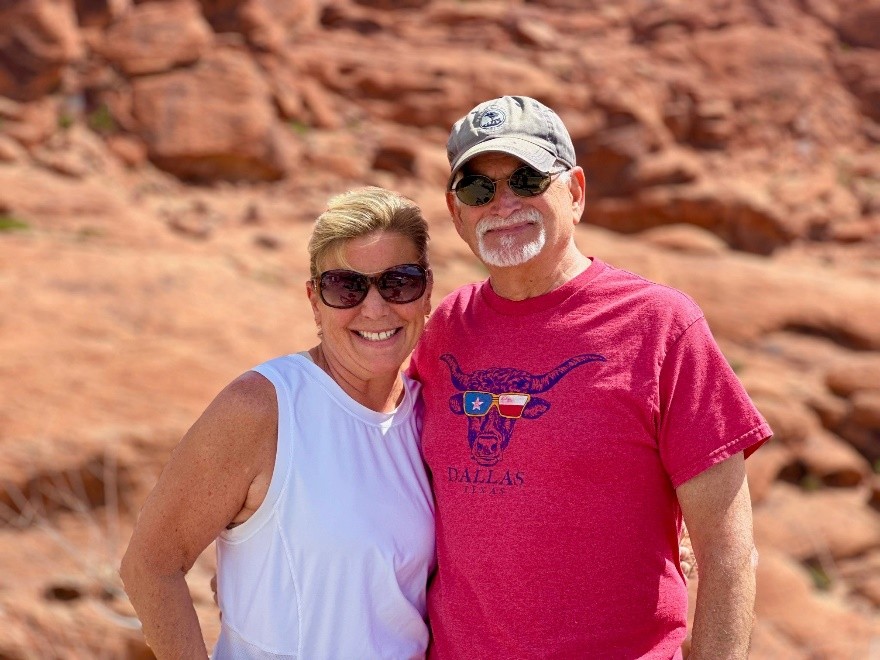
Sue and Tom Devine
Both women reported going home about a day after their surgeries, and they each said their pain level was minimal. “I had a narcotic in the hospital once, and then it was just Tylenol®,” Devine said.
“The pain was very manageable,” Babu said. “I would say it was really close to nothing. I had some fatigue but I would say it was really good, and really easy for me. I can’t compare it to the other type of surgery, because, of course, I didn’t have it, but I feel as if it this was easier and smoother than anything else would have been.”
In both cases, because robotic donor nephrectomy is new at YNHH, a variety of experienced experts (including some from another leading out-of-state medical institution) were in the room to collaborate. The da Vinci 5 robot also has a “tele proctor” feature to allow surgeons from another center to join an operation virtually.
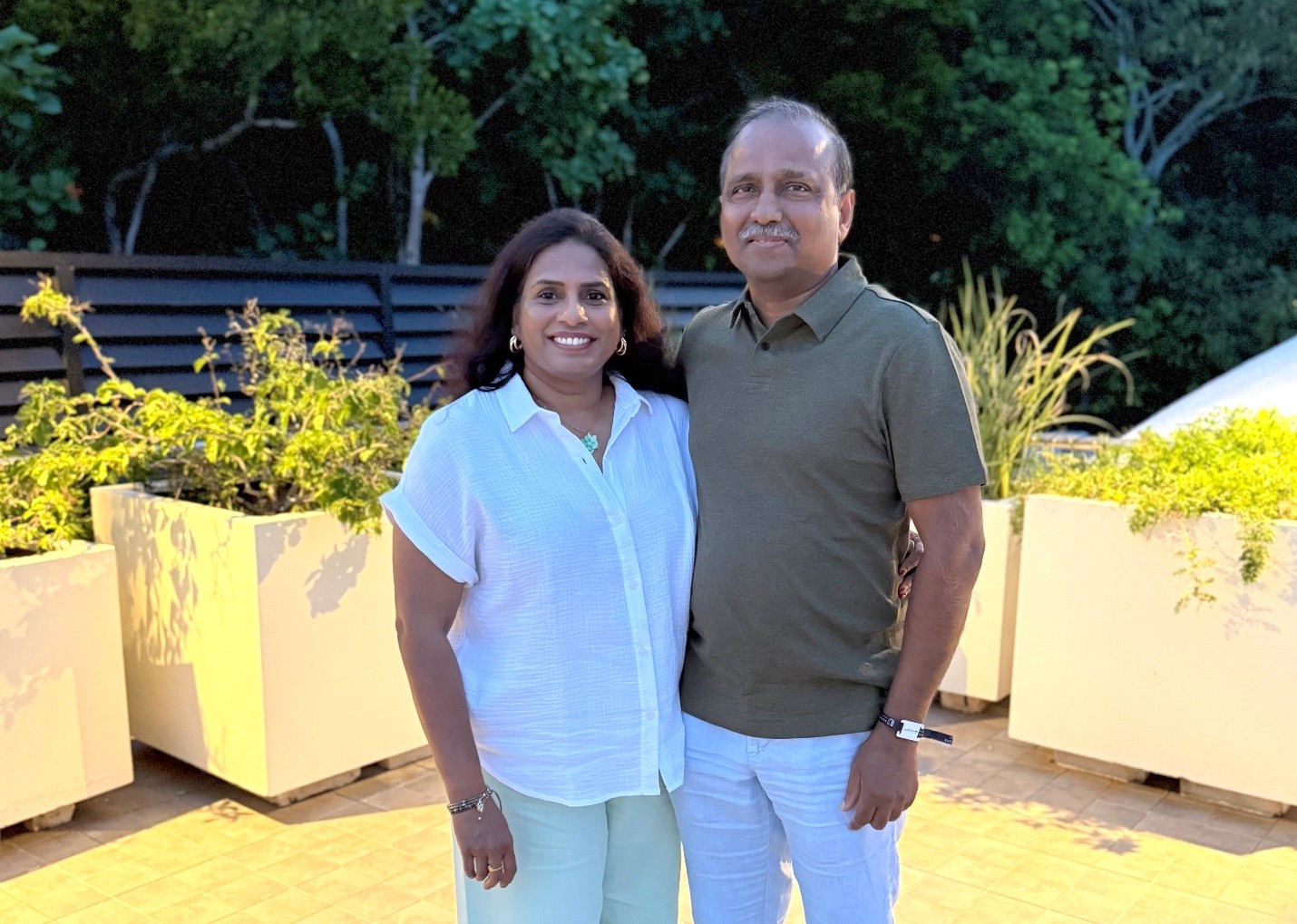
Deepa Babu and her husband, Jeyakumar Subbaraj
Looking back on the entire transplant process, both women said the Yale New Haven Hospital approach was holistic and extensive. Babu, for example, met with the surgical team, social workers, dietitians and nurse practitioners, all to ensure she was fully prepared in every way for the operation.
“I am deeply grateful to the entire transplant team for the exceptional care, compassion and expertise they provided, from my first pre-operative appointment through surgery and recovery,” Babu said. “Every member of the transplant team treated me with kindness, professionalism and genuine concern. I thank them for helping me feel safe, supported and cared for every step of the way.”
Devine agreed. “The entire transplant team, they’re a very tight group,” she said. “First of all, they’re all super smart, highly intelligent people, and they work as a cohesive unit. They’ve got social workers and advocates and dietitians and pharmacists – you name it, they’ve got it. They make sure the donor is fully vetted. They made sure I was healthy, that my kidneys were super healthy, and they look at your mental health, too. Are you doing it out of free will, and are you going to be OK with it? They really want to make sure you’re not going to regret it.”
For anyone considering donating a kidney to a loved one, or possibly to a stranger in need, Babu offered a few words of encouragement. “It is a big decision, but since it was my husband, I jumped into it. But, to anybody who’s thinking about it, it’s definitely worth it. There’s so much happiness and the satisfaction after doing it,” she said.
“I was so thrilled that I had a chance to do this for Tom,” Devine said. “It’s an incredibly wonderful feeling to be able to give a loved one back the freedom to live their life as it was.”
In fact, Devine also encourages others to seriously think about organ donation. She noted that a healthy person can easily live a robust life with just one kidney. “There are 90,000 people in America who are on the national waiting list for kidneys,” Devine said. “That’s a lot of people. I would encourage everyone to at least become an organ donor on their driver’s license, because why not? You might save a life.”
To learn more about transplant at Yale New Haven Hospital, visit Transplantation - Yale New Haven Hospital. For more information and a list of frequently asked questions, please visit the YNHH website page, Center for Living Organ Donors.