Published July 29, 2026

Marissa Cullen, 45, was walking on a lacrosse field in Madison, CT one afternoon when she realized she just didn’t feel right. Because she had experienced a cardiac event in 2023 – and because her sister died of a heart attack at age 36 – Cullen wasn’t taking any chances.
“It wasn’t anything dramatic. It was just an uncomfortable feeling in my chest,” she said. “I felt like I couldn’t take a deep breath. I didn’t have pain radiating down my arm, I didn’t have pain in my back. I didn’t have anything in my jaw – nothing that they tell you to look for with a cardiac issue.”
One thing Cullen did have, however – and she knew it – was a specific type of a potentially dangerous blood lipoprotein that is little known and not routinely tested for in standard cholesterol lipid panel blood tests.
After Cullen’s cardiac episode in 2023, which ultimately required a cardiac catheterization and placement of a stent to keep one of her arteries open, Cullen’s new Yale New Haven Hospital (YNHH) Heart and Vascular Center (HVC) cardiologist ordered a previously unordered test. Andrew Levin, MD, professor of cardiovascular medicine at Yale School of Medicine (YSM), decided to test Cullen for “L.P. Little A,” or Lp(a).
Lp(a), is a lipoprotein similar to LDL or “bad” cholesterol, but it carries an “extra sticky” protein that makes it very likely to adhere to artery walls. Lp(a) is a genetically inherited type of cholesterol that does not significantly change over time, nor does it typically change with diet, exercise or cholesterol lowering medications like statins.
“The American College of Cardiology now recommends an Lp(a) screening blood test at least once in all adults for cardiac risk assessment,” said Stephen Possick, MD, a cardiologist with YNHH HVC and assistant professor of cardiovascular medicine at YSM.
Dr. Possick also believes in the importance of Lp(a) testing for his patients. “It’s a genetically determined cholesterol particle that promotes atherosclerotic cardiovascular disease, and testing for Lp(a) can really help identify individuals at higher risk for disease, and it can help influence decisions regarding treatment of high cholesterol.”
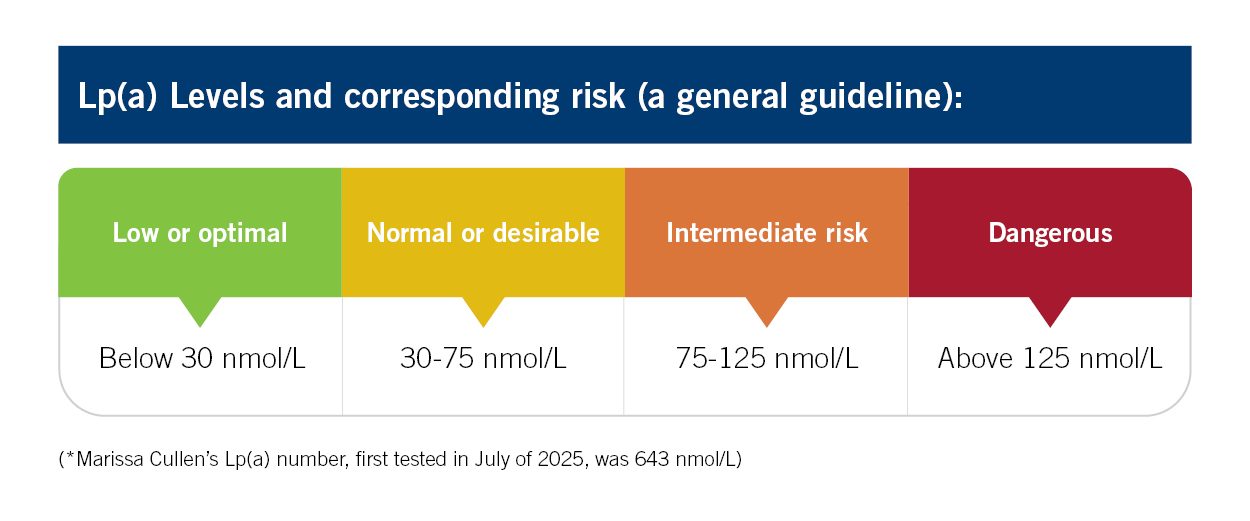
The normal, safe range for Lp(a) is generally considered to be below 75 nmol/L, or nanomoles per liter. Low, or optimal, is below 30 nmol/L; 30-75 is normal or desirable, 75-125 nmol/L is intermediate risk, and anything above 125 nmol/L is considered high risk for cardiovascular disease.
Cullen’s Lp(a) number, first tested in July of 2025, was 643 nmol/L.
Cullen’s overall cholesterol was being managed with statins and other medications (she has also taken injectable cholesterol lowering medications known as a PCSK inhibitors) and her overall cholesterol was 117 (the general goal is lower than 200). Her LDL or bad cholesterol was 50, well below the general guideline of below 100.
But, as Cullen crossed that lacrosse field, knowing her Lp(a) number was very high, and knowing her own personal and family history, she took herself to the Yale New Haven Health emergency department at Goose Lane in Guilford.
“I had a phenomenal ER doctor, Beatriz Sánchez-Rodríguez, MD,” Cullen recalled. “She looked at my chart, she took into account my symptoms, and while my numbers seemed fine, she put me in an ambulance and had me transported to New Haven to be admitted directly to the cardiac floor.”
Dr. Sanchez-Rodriguez remembered Cullen’s case. “Marissa’s work-up was stone-cold normal, but her medical and family history were concerning,” she said. After noting that Cullen’s symptoms worsened with exertion, Dr. Sanchez-Rodriguez advocated with the on-call cardiologist at YNHH for Marissa to be admitted.
In New Haven, another “wonderful” doctor, said Cullen, cardiologist Erica Spatz, MD, of HVC, guided Cullen’s care, and, sure enough, a trip to the cardiac catheterization lab identified two more dangerous coronary artery blockages. Cullen had two additional stents implanted to help keep her arteries open, ensuring a vital supply of oxygen to her heart.
Despite these interventions, however, Cullen’s cardiovascular concerns remain serious. Since there are no current medications approved to lower Lp(a), Cullen is exploring options for a type of treatment called lipoprotein apheresis, which is similar to kidney dialysis. Blood is removed via an IV, filtered through a machine to remove Lp(a) and LDL cholesterol, and then returned to the body.
“Marissa is an amazing advocate for cardiovascular health, prevention and awareness,” Dr. Levin said. “Despite her genetic predisposition for cardiovascular disease, she has worked incredibly hard to optimize her modifiable risk factors that can contribute to coronary artery disease, such as healthy lifestyle and intensive lowering of other plaque-forming cholesterol particles such as LDL. By doing so, this lowers her risk of cardiovascular events with genetically determined high lipoprotein (a).”
Cullen strongly encourages others to consider getting tested for “L.P. Little A,” as she calls it, “especially since it’s not typically included in your normal blood panels,” she said. “I’m still learning so much about this condition and what the treatment options are, which unfortunately are very limited. I think that within the next few years we’re going to see a rapid rise in people who have been diagnosed with high hereditary cholesterol and high lipoprotein numbers. All I can hope is that there’s actually a medication soon that will be effective.”
Dr. Possick noted that a number of medications targeting Lp(a) are in the clinical trial stage. “New guidelines also introduce more aggressive LDL cholesterol targets for higher risk patients and recommend coronary calcium scoring to help guide management in certain individuals,” he said. “These tools can help physicians and patients better understand individual cardiovascular risk, leading to earlier intervention to reduce the risk of heart attacks and stroke.”
Cullen can’t help but wonder if her sister’s premature death due to a cardiac event may have been related to high Lp(a). “Since the lipoprotein is not part of a standard lipid panel, I certainly don’t think this was something she was ever tested for,” Cullen said. “However, I would presume that she also had a high Lp(a) level. Unfortunately, we will never know.”
After her experiences, Cullen also encourages everyone to be proactive if you think you or a loved one might be experiencing a cardiac event. “I took myself to the emergency room when I didn’t feel right, even though I didn’t have any of the traditional signs of a heart attack,” she said. “But a lot of people might say to themselves, ‘I don’t want to sit in the emergency room for hours just to have them tell me I’m fine.’ Or ‘I’ll wait and talk to my doctor later, or I’ll go to walk-in care tomorrow.’ But, when it’s critical, sometimes you just need to go. If I had let it go, I could have had a fatal cardiac event.”
Cullen especially urges women to be strong self-advocates when it comes to their health. “I didn’t have all the answers. I didn’t know exactly what was wrong. But I knew I didn’t feel right,” she said. “Today, I tell people to get tested – and to listen to your body. If you think something’s wrong, don’t take no for an answer.”