Published October 06, 2026

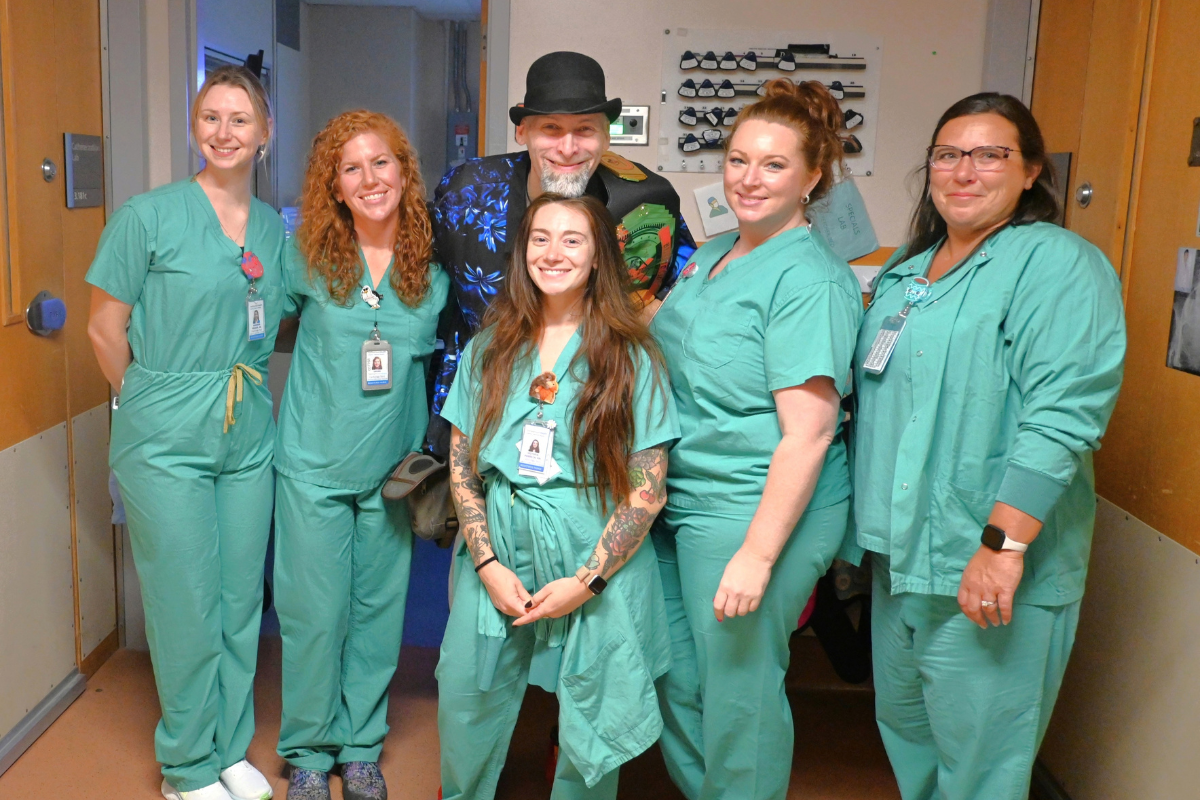
When Joel Deeter, 54, of New London, arrived at L+M Hospital recently to see some of his former caregivers, the leukemia survivor with an outsized personality and a physical presence to match, was greeted as part conquering hero, part beloved family member.
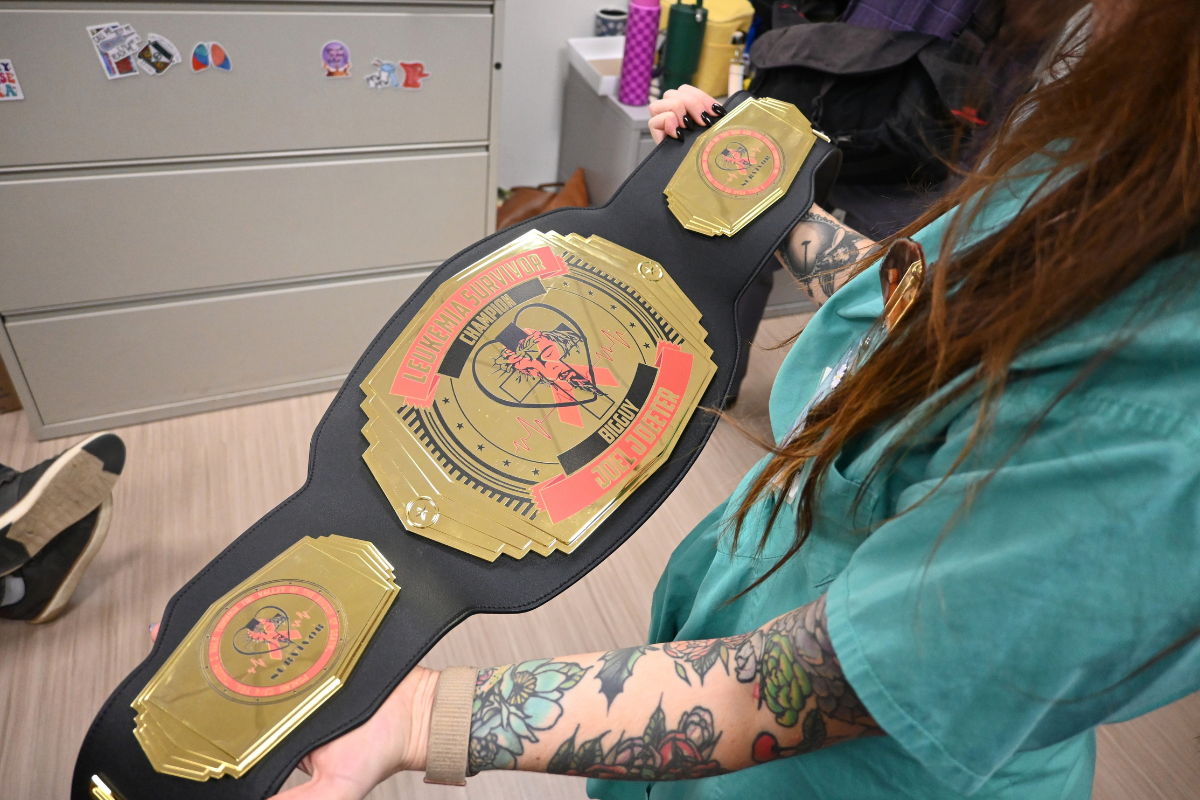
The hero part fit because Deeter – already decked out with multiple wrist and ankle bracelets, red sneakers, a bowler hat, Hawaiian shirt and a stuffed lion clinging to his wrist – also carried a pro-wresting-style belt with a massive, gold buckle proclaiming “Leukemia Survivor Champion/Big Guy Joel Deeter.”
The family part fit, too, because Deeter, during his battle with cancer, had such genuine interactions with his caregivers that the L+M staff all agreed he had become “like family.”
Deeter’s return to L+M coincided with a hospital awareness campaign for National Leukemia Awareness Month, and the 6-foot-7-inch survivor shared stories about his battle with the disease while sitting in a break room next to L+M’s catheterization laboratory – the same lab where he had a port implanted to deliver the chemotherapy he received at Smilow Cancer Hospital in Waterford. That therapy that eventually put him in remission against a potentially deadly disease.
Leukemia is a type of blood cancer that originates in the bone marrow. It occurs when a genetic mutation causes the body to rapidly produce abnormal, dysfunctional white blood cells. Those abnormal white blood cells can travel freely throughout the circulatory system, and this means they can migrate to and accumulate in organs; Deeter’s disease was detected primarily in his liver.
But while he received his chemotherapy at Smilow Cancer Hospital in Waterford, Deeter became a regular at L+M’s cath lab because of one of his disease symptoms. The buildup of excess fluids in his abdomen required regular paracentesis, a procedure where a needle-like catheter is used to draw that excess fluid from the body. Deeter recounted those difficult days while simultaneously catching up with staff, hugging his former caregivers, looking at cell phone pictures of nurses’ children (Deeter is also a self-proclaimed “Professional Father” of five), and sharing the excitement over one nurse’s recent engagement.
“I call them my angels,” Deeter said, barely holding back tears as he talked about his caregivers at L+M and Smilow. “It was a very difficult time. But I was never alone. I always felt like there was someone there with me, whether it was my kids, my wife, my mom, or these amazing nurses and doctors. These folks, they not only helped me through it, they laughed with me, they cried with me. They were alongside me. I have never felt so cared for in my life.”
Victoria Porreca, RN, a cath lab nurse, said Deeter’s positivity was contagious. “Even though Joel was going through chemo and coming in weekly, he and his family always had the best attitude,” she said. “I just gravitated to him. I always appreciated taking care of him.”
Deeter’s cancer was initially detected through routine blood work in advance of a surgical procedure for an old spine injury. When the results came in, and his primary care physician asked if he could come to the office immediately, “I knew something was up,” he recalled.
Benjamin Newton, MD, a hematologist/oncologist and medical director at Smilow in Waterford and Westerly, said Deeter had chronic lymphocytic leukemia, a type of leukemia that is relatively common, and usually treatable.
“The most powerful tool we have for catching leukemia is standard blood work,” Dr. Newton said. “A simple Complete Blood Count (CBC) can flag abnormal cell changes long before you feel sick, and this is essentially what happened to Joel.”
If a patient has no symptoms, like Deeter, sometimes monitoring the patient through repeated blood work is the first strategy against his type of leukemia. Deeter was monitored for nearly two years before his level of disease reached a critical treatment stage, Dr. Newton said.
The wait for treatment was difficult for Deeter. “I had a timebomb in me and I didn’t know when it was going to go off,” he said. “When they finally said it was time to start chemo, I knew it was going to be a hard path, but at least I was moving. I could start working toward the goal (of remission).”
As it sometimes does, chemotherapy gave Deeter chills. “I have never been so cold in my life,” he said. “I was wearing sweatpants, two T- shirts, a sweatshirt, blankets – and I’m still shivering like I’m in a snowstorm.”
Thanks to those powerful medications, however, Deeter’s blood work got better so quickly that an estimated 18-month regimen was shortened to just four months. His port was removed in the L+M Cath Lab in late 2025.
“It was like a victory celebration,” noted Sarah La Flair, RN, clinical coordinator of the Cardiac Cath Lab and Interventional Radiology. “We don’t always get to take a port out for a good reason. In some cases we’re taking out a port because the patient is going on hospice or palliative care. But when Joel came back, taking that port out was like the cherry on top.”
Throughout it all, Deeter helped his own cause with humor, charm and determination, said John Michalak, APRN, who often led the paracentesis procedures. “It was never a bad day when Joel came in,” Michalak said. “He had the best attitude.”
Deeter said he implicitly trusted the L+M team, Dr. Newton, and the Smilow team. “I’m from New London and I was born at this hospital, and they all took care of me like I was one of their own,” he said. “They saw me at my absolute worst, but they offered me a measure of dignity during a very undignified situation. And I can’t thank them enough.”
Dr. Newton said Deeter’s perseverance and clinical success should serve as an inspirational reminder to others. “I encourage people to see your doctor if you are experiencing any persistent, unexplained fatigue, infections or unusual bruising or bleeding,” he said. “Don’t dismiss it. Bring these changes to your doctor right away, because sometimes a simple blood test can make all the difference.”







.ashx?mh=300&mw=400&hash=693DB0E087DDE8D8A798DF819DB836FF)