Published June 04, 2026

Worth every mile for the best cancer treatment, according to one patient
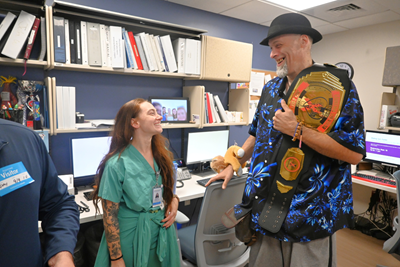
Charles “Chuck” Padera did his research.
When the retired fish and game biologist/engineer discovered he had prostate cancer, he put his scientific mind to work.
Padera began researching all potential options for a cure, and there are many. When he found the procedure he felt best suited his specific condition, he drilled down even more, searching for the best places to get that precise type of care.
Padera’s search led him to Yale New Haven Hospital (YNHH) for a newer minimally invasive procedure known as TULSA, or Transurethral Ultrasound Ablation. Padera had the procedure several years ago, and YNHH recently celebrated the successful completion of its 100th TULSA case, a significant milestone since the procedure is not offered at many other healthcare institutions.
“It was top notch,” Padera recalled. “The people were wonderful, and the technology seems to be working for me. I was very impressed. Kudos to the team at Yale New Haven Hospital.”
Transurethral Ultrasound Ablation is a minimally invasive, MRI-guided procedure used to treat conditions of the prostate, including enlarged prostate and prostate cancer. The procedure delivers controlled ultrasound energy through the urethra to precisely destroy targeted prostate tissue. This approach helps eliminate cancerous cells while protecting surrounding healthy structures.
By treating the prostate from within the urethra, TULSA can also improve urinary symptoms and reduce the risk of damage to nearby organs. For Padera, the procedure was highly effective.
Padera’s prostate saga began when he was in his 50s and was treated for BPH or benign prostatic hyperplasia, a common form of prostate enlargement not caused by cancer. At the time, Padera’s PSA level – (PSA is a blood test reading of a “prostate specific antigen” that indicates the likelihood of prostate cancer) was slightly elevated, but he had no signs of cancer. When medication helped reduce the size of his prostate and his PSA dropped, Padera was given a clean bill of health and had no prostate concerns for many years.
However, since cancer did run in Padera’s family – and when his PSA began rising again – he took matters into his own hands. “I decided to get an MRI of the prostate which showed a lesion in a location that a digital exam would not likely discover,” he said. After some mapping and biopsies of the lesion, Padera was informed he had cancer.
More research ensued. “I wanted to know about the cancer beyond just the normal typing,” Padera said. “I wanted to get a genomic test to see just how aggressive my particular cancer was.”
The genomic test came back favorable; Padera’s type of cancer was not particularly aggressive; indeed, many types of prostate cancer are similarly slow growing.
For men diagnosed with prostate cancer, the number of options available can be confounding, ranging from simple surveillance for older men with low-risk cancer to radical prostatectomies, radiation and chemotherapy for patients with aggressive types of cancer and/or metastatic cancers. There are many types of newer and less invasive procedures that are often viable options for certain patients. They include HIFU (High-Intensity Ultrasound), laser ablation, IRE (irreversible electroporation), cryotherapy – and TULSA.
After deciding on TULSA, Padera’s next challenge was to pick the healthcare facility that would suit his exacting criteria, which included “competency, cost and convenience,” he said.
“I talked to people in California, I talked to people in Pennsylvania, in Texas, in Florida. I even researched and communicated with people in Finland,” he said. “The place that ultimately best met all my criteria was Yale New Haven Hospital.”
Padera made the drive to YNHH from his home in Maine to meet with Preston Sprenkle, MD, a urologist and surgical oncologist with YNHH and an associate professor of Urology with Yale School of Medicine. Dr. Sprenkle is a pioneer in “focal therapy,” which allows a surgeon to treat tiny prostate lesions, rather than the whole organ. This avoids many of the side effects – such as erectile dysfunction and incontinence – that may follow the removal of the whole prostate.
“We look at all factors and work with our patients to select the right treatments and therapies for every individual’s particular type of cancer, taking into account the stage of their cancer, their age, their lifestyle and personal preference,” Dr. Sprenkle said. “When we heard from Chuck that he wanted to try to TULSA, we reviewed his case and felt he was indeed an excellent candidate for that type of treatment. And that’s one of the things we strive for. We want our patients to understand their options and feel comfortable with their decision.”
Dr. Sprenkle noted that during a TULSA procedure, ultrasound allows for precise, real-time monitoring of the prostate. “This enables us to treat the cancer very accurately while protecting important surrounding structures like the tissues responsible for continence and sexual function,” he explained. “For the patient, this means no incisions, a lower risk of side effects, and typically a quicker recovery compared to many other more traditional treatments.”
Padera described it in a similar way, from his well-researched layman’s perspective. “They work hard to avoid ablating any nerves or anything that could compromise your ability to have sex or to urinate,” he said. “And they were very good at that.”
Today, Padera is happily living his life – at age 72. He’s working on projects around the house, exploring the outdoors, cooking steaks on the grill and enjoying time with wife. And most importantly, he’s not worrying about cancer. But he does have advice for any man facing a diagnosis of prostate cancer.

“In today’s world, people should take advantage of the information that’s out there and do their research,” Padera said. “If you don’t ask the questions, you may miss out on other options that could help you maintain a better quality of life.
“The nice thing for me, after having TULSA, is that, if the cancer ever does come back, I still have all the other options available to me,” Padera noted. “I could go forward with a prostatectomy or radiation, if necessary. Or, if the area is subject to ablation, they could go in and ablate a little bit more. So, I highly recommend that people become familiar with procedures like TULSA. Doctors will tell you whether you’re an ideal candidate or not.”
Dr. Sprenkle said he and his colleagues at YNHH and Yale School of Medicine encourage the kind of open dialogue that Padera recommends.
“Exciting technological advances are revolutionizing urology,” Dr. Sprenkle said. “Prostate cancer is very common and current treatments can majorly impact a man's sexual and urinary function. As a urologist, developing ways to minimize the impact of prostate cancer on a man's health and quality of life is tremendously rewarding.
“I want my patients to feel that I hear their concerns and treat them like a person,” Dr. Sprenkle added. “I am pleased at the end of a long consultation when they feel like they understand their disease and their options.”