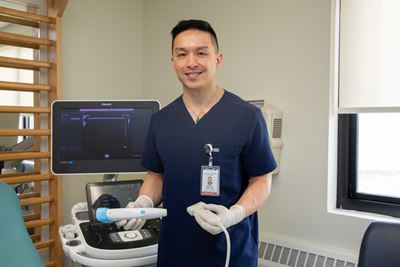
When your pain is well controlled, you are better able to be an active participant in all aspects of your life. Our healthcare team works closely with each patient to prevent and relieve pain and discomfort. Treatment begins with a thorough evaluation by a board-certified pain management specialist. Yale New Haven Health offers highly individualized inpatient and outpatient care to help people lead productive, enjoyable lives, free of the complications of chronic pain. Because each person perceives pain differently, patients are encouraged to be active partners in their care. Continued personal involvement is key to proper diagnosis and the most successful treatment and rehabilitation possible. Whether your pain is from surgery, illness, accident or another cause, our pain specialists employ a wide variety of therapies to provide relief for your specific condition. The medical team consists of board-certified pain management physicians, physician assistants, nurse practitioners, nurses and radiology technicians.
New advances in pain management offer patients a growing number of options.
All treatments are same-day, minimally-invasive, and image-guided for safety and to provide the best possible outcomes.
treats chronic low back pain due to degenerative disease. This treatment is used in carefully selected patients by specifically targeting pathology in the lumbar spine.
to treat migraines that have not responded to medication.
Low-intensity electrical nerve stimulation can sometimes treat chronic (ongoing) pain problems by decreasing pain signals to the brain.
to treat pain arising from nerve impingement caused by disc herniations and arthritis. Examples are cervical, thoracic and lumbar epidurals.
using ultrasound or x-ray to place medication into a painful joint to alleviate symptoms. Examples are injections to relieve shoulder, knee, hip, facet and SI (sacroiliac) joint pain.
corrects the main cause of lumbar spinal stenosis to help improve pain and mobility.
local anesthetic is used with or without steroids to selectively target nerves around the source of pain to alleviate symptoms. Examples are medial branch blocks and peripheral nerve blocks.
Anti-inflammatory drugs reduce swelling, anti-spasmodics relax muscles and anti-seizure medications control pain from damaged nerves by resetting nerve conduction thresholds.
targets and treats nerves that are painful to provide long-term pain relief. This treatment can be applied to many areas of the body including the neck, back, shoulder, groin and knee.
use a patient’s own blood cells to accelerate healing in various conditions, such as joint and tendon injuries.
uses heat to selectively destroy nerve tissue from arthritic joints in the neck, back and joints to lessen or eliminate pain signals.
delivers small electrical currents at the spinal cord to alter a patient’s perception of pain signals coming from various parts of the body and provide relief.
On rare occasions, surgical treatment may be suggested for long-term improvement of selected chronic pain conditions.
are a procedure that can offer pain relief in neuropathic pain, visceral pain and vascular pain.
treat pain from muscle spasms to help improve stiffness, range of motion and pain.
Yale New Haven Health
Bridgeport Hospital
Greenwich Hospital
Lawrence + Memorial Hospital
Northeast Medical Group
Smilow Cancer Hospital
Yale New Haven Children's Hospital
Yale New Haven Hospital

The opioid crisis has pushed the field of medicine to reduce the use of the powerful painkillers leaving many patients and physicians searching for alternative ways to address pain.
Read More
Yale New Haven Health is proud to be affiliated with the prestigious Yale University and its highly ranked Yale School of Medicine.